FAQs
Frequently asked questions
The questions readers and analysts ask the BusinessStats research team most often about the FIFA World Cup 2026 — host cities, format, prize money, costs, broadcasting, and tournament economics — answered with the latest 2026 data from FIFA disclosures, host-nation budgets, and independent research.
What is FIFA?+
FIFA — the Fédération Internationale de Football Association — is the global governing body for soccer, headquartered in Zürich, Switzerland. Founded in 1904 in Paris, it now has 211 member associations worldwide — more than the United Nations has members. FIFA organises the men’s and women’s World Cup, the Club World Cup, and several youth and futsal competitions, and oversees the laws of the game internationally.
How much revenue does FIFA generate?+
FIFA’s revenue is reported in four-year cycles tied to each World Cup. The 2023-2026 cycle is projected to generate over $11 billion — the highest in FIFA history. Revenue comes mainly from television broadcasting rights (~50%), marketing rights and sponsorships (~25%), ticketing and hospitality (~15%), with the rest from licensing and other commercial streams.
Which country has won the most men's World Cup titles?+
Brazil leads with five men’s World Cup titles (1958, 1962, 1970, 1994, 2002), followed by Germany and Italy with four each. Argentina holds three (1978, 1986, 2022 — the most recent), and France, Uruguay, England and Spain each have one. Brazil is also the only country to have qualified for every World Cup tournament since the competition began in 1930.
Which country has won the most Women's World Cup titles?+
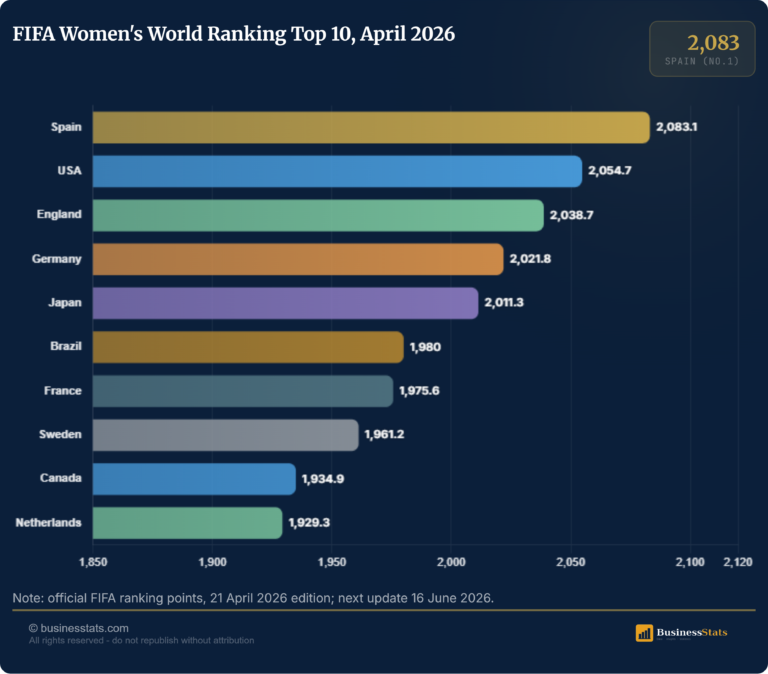
The United States women’s national team holds the record with four FIFA Women’s World Cup titles (1991, 1999, 2015, 2019). Germany has two titles (2003, 2007), and Norway, Japan and Spain each have one. The 2027 Women’s World Cup will be hosted by Brazil — the first time the tournament will be held in South America.
Who was the most recent FIFA Best Men's Player?+
Vinícius Júnior of Real Madrid and Brazil won the most recent FIFA Best Men’s Player award. The award has been dominated in recent years by Lionel Messi (record 8 wins counting the Ballon d’Or and FIFA Best combined), Cristiano Ronaldo, Karim Benzema and Erling Haaland. The FIFA Best award has been issued in its current form since 2016.
Who was the most recent FIFA Best Women's Player?+
Aitana Bonmatí of Barcelona and Spain picked up the most recent FIFA Best Women’s Player award. Other recent winners include Alexia Putellas (also of Spain and Barcelona), Megan Rapinoe of the U.S., and Lucy Bronze of England, reflecting how European clubs and national teams now dominate the women’s game.
Where does FIFA's money go?+
FIFA reinvests the majority of its revenue back into football. Roughly 50% of total expenses go to running the men’s and women’s World Cups, while another large portion funds development grants to the 211 member associations through programmes like FIFA Forward. FIFA also funds youth tournaments, futsal, beach soccer, refereeing development, and governance / compliance costs.
Has FIFA had governance scandals?+
Yes. The most significant came in May 2015 when U.S. and Swiss authorities indicted multiple senior FIFA officials on corruption charges, leading to the resignation of long-time president Sepp Blatter and a series of bans from football. Since 2016, under President Gianni Infantino, FIFA has implemented governance reforms including term limits, an independent ethics committee, and stricter financial controls.
How big is the Club World Cup becoming?+
FIFA has expanded the Club World Cup from a 7-team event into a 32-team tournament every four years, modelled on the World Cup format. The first edition of the expanded Club World Cup took place in summer 2025 in the United States, with a prize pool exceeding $1 billion — aimed at making it FIFA’s second-biggest commercial event after the men’s World Cup.
How does the FIFA World Ranking work?+
FIFA publishes monthly rankings for both men’s and women’s national teams based on the SUM ranking method: teams earn or lose points after every official match using a weighted system that factors in the importance of the match, the strength of the opponent (based on Elo-style ratings), and the result. As of 2026, top contenders in the men’s ranking include Argentina, France, Spain, England and Brazil.
What is the outlook for FIFA?+
FIFA is positioned for sustained commercial growth through 2030 and beyond, driven by the expanded 48-team World Cup in 2026 (USA, Canada, Mexico), the new 32-team Club World Cup, expanding women’s football commercial value, and rising broadcast and sponsorship revenue. The 2030 World Cup will be held across six host countries (Spain, Portugal, Morocco, plus centenary matches in Argentina, Uruguay and Paraguay), and the 2034 edition has been awarded to Saudi Arabia.