
Highest-paid National Basketball Association (NBA) players in 2025/26
The NBA's 2025/26 season represents a watershed moment in professional basketball economics. For the first time in league history, a player's single-season salary has crossed $55 million — with Stephen Curry's $55,761,217 contract year setting the all-time record. The total league payroll of $5.1 billion reflects the NBA's extraordinary revenue growth: from approximately $3.8 billion in revenue (2010) to approximately $12 billion in 2025/26 — a 216% increase driven by the landmark $76 billion national TV deal, digital media expansion, and the league's surging international popularity. The NBA's business dynamics are tracked alongside other major industries in our global market capitalization analysis, where NBA parent league entities and franchise values are increasingly significant.
- Highest salary ever: Stephen Curry $55,761,217 — first time in NBA history a player earns $55M+ in a single season
- Total payroll: $5.1B across 30 teams — average team payroll ~$170M
- $50M+ club: 5 players earn $50 million or more — unprecedented in league history
- $30M+ earners: Approximately 30 players — up from just 3 in 2016/17
- Average salary: $11.2M — highest average in all North American professional sports
- NBA vs NFL average: NBA $11.2M vs NFL $3.9M — NBA average is 2.9× higher
Highest-Paid NBA Players 2025/26 — Full Rankings Table
The complete top 30 salary rankings are below. Click any column header to sort by salary, team, or position. All figures are base salaries — excluding endorsements and incentives.
| Rank | Player | Team | 2025/26 Salary | Pos. | Contract Type |
|---|---|---|---|---|---|
| 1 | Stephen Curry | Golden State Warriors | $55,761,217 | PG | Supermax Ext. |
| 2 | Nikola Jokic | Denver Nuggets | $51,415,938 | C | Supermax Ext. |
| 3 | Joel Embiid | Philadelphia 76ers | $51,415,938 | C | Supermax Ext. |
| 4 | Kevin Durant | Phoenix Suns | $51,179,021 | SF | Veteran Max Ext. |
| 5 | Jayson Tatum | Boston Celtics | $50,203,630 | SF | Max Ext. (5yr/$315M) |
| 6 | Devin Booker | Phoenix Suns | $49,279,050 | SG | Max Extension |
| 7 | Karl-Anthony Towns | New York Knicks | $49,279,050 | C | Max Extension |
| 8 | LeBron James | Los Angeles Lakers | $48,743,826 | SF | 2yr/$97.1M Ext. |
| 9 | Damian Lillard | Milwaukee Bucks | $48,743,826 | PG | Supermax Ext. |
| 10 | Giannis Antetokounmpo | Milwaukee Bucks | $48,743,826 | PF | Supermax Ext. |
| 11 | Luka Doncic | Los Angeles Lakers | $46,574,216 | PG | Supermax Ext. |
| 12 | Anthony Edwards | Minnesota Timberwolves | $43,892,000 | SG | Max Rookie Ext. |
| 13 | Anthony Davis | Los Angeles Lakers | $43,219,440 | C | Veteran Max |
| 14 | Rudy Gobert | Minnesota Timberwolves | $41,000,000 | C | Max Extension |
| 15 | Shai Gilgeous-Alexander | Oklahoma City Thunder | $40,064,220 | PG | Supermax Ext. |
| 16 | Ja Morant | Memphis Grizzlies | $40,411,200 | PG | Max Rookie Ext. |
| 17 | Zion Williamson | New Orleans Pelicans | $37,480,428 | PF | Max Rookie Ext. |
| 18 | Jimmy Butler | Golden State Warriors | $48,798,077 | SF | Max Extension |
| 19 | Bam Adebayo | Miami Heat | $32,600,000 | C | Max Extension |
| 20 | Jalen Brunson | New York Knicks | $32,000,000 | PG | Max Extension |
| 21 | Donovan Mitchell | Cleveland Cavaliers | $35,905,760 | SG | Max Extension |
| 22 | Kyrie Irving | Dallas Mavericks | $40,864,080 | PG | Max Extension |
| 23 | Paul George | Philadelphia 76ers | $38,388,000 | SF | Max Extension |
| 24 | Jaylen Brown | Boston Celtics | $49,644,000 | SG | Supermax Ext. |
| 25 | Kawhi Leonard | Los Angeles Clippers | $48,671,700 | SF | Max Extension |
| 26 | Trae Young | Atlanta Hawks | $40,064,220 | PG | Max Extension |
| 27 | Zach LaVine | Chicago Bulls | $43,858,447 | SG | Max Extension |
| 28 | Pascal Siakam | Indiana Pacers | $37,504,920 | PF | Max Extension |
| 29 | Draymond Green | Golden State Warriors | $22,315,500 | PF | Veteran Contract |
| 30 | Brandon Ingram | New Orleans Pelicans | $33,234,960 | SF | Max Extension |
The NBA's salary structure is uniquely egalitarian among professional sports — the Collective Bargaining Agreement (CBA) between the NBA and the NBPA (players union) governs maximum contracts, minimum salaries, and revenue sharing. Players collectively receive 49–51% of Basketball Related Income (BRI). As NBA revenue has grown, so have maximum contracts: the 2016 TV deal caused a one-time salary cap spike from $70M to $94M, creating the era of supermax contracts that now pay franchise players up to 40% of the cap. The broader sports economics connecting NBA player earnings to brand value is covered in our sports brands statistics and revenue analysis. For player statistics and performance context, see our NBA player stats 2025/26 report.
- CBA revenue split: Players receive 49–51% of Basketball Related Income (BRI)
- Supermax eligibility: Players must be All-NBA, All-Star, or MVP in prior season to earn 35-40% of cap
- Cap growth driver: NBA revenue $3.8B (2010) → $12B (2026) — driven by TV deals, digital, global expansion
- 2016 cap spike: Cap jumped from $70M (2015/16) to $94M (2016/17) — created today's contract era
- New CBA 2023: Stricter luxury tax rules, second apron restrictions limiting high-payroll teams
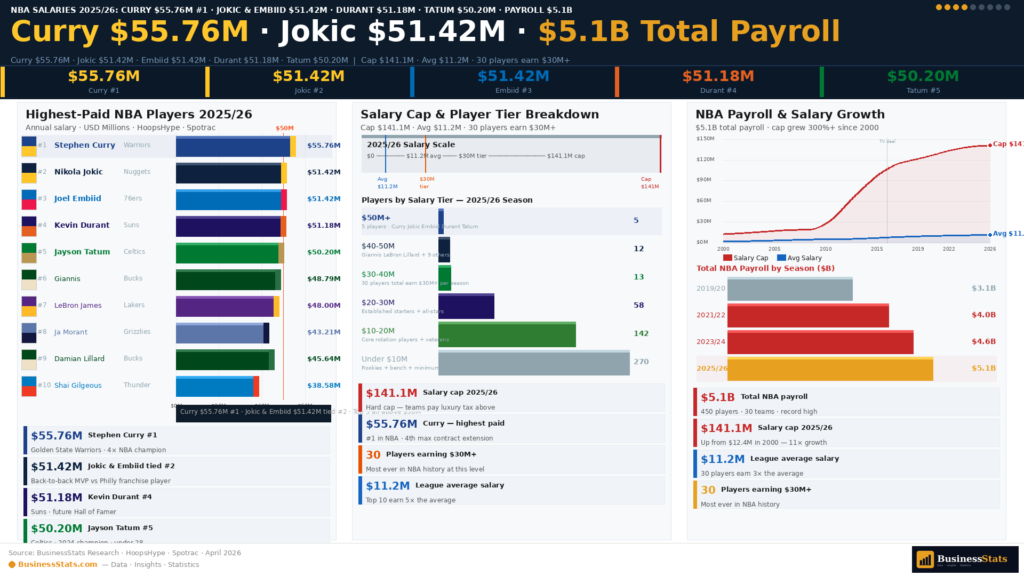
Top 10 Highest-Paid NBA Players in 2025/26
Stephen Curry sits atop the NBA salary rankings at $55,761,217 — the final year of the 4-year, $215.4 million supermax extension he signed with the Golden State Warriors in August 2021. The 4-time champion and 2-time MVP is widely considered the most impactful player in NBA history relative to his listed position, having single-handedly transformed the game through his 3-point shooting revolution. Curry's salary represents approximately 39.5% of the 2025/26 salary cap — the maximum allowable for a player with 10+ years of service. His total NBA career earnings have surpassed $350 million in guaranteed salary, and his endorsement empire (Under Armour, Chase Bank, Rakuten, FTX controversially) adds an estimated $50M+ annually in off-court income. The sports brand dynamics behind Curry's commercial empire are tracked in our sports brands revenue analysis.
- #1 Stephen Curry (Warriors): $55,761,217 — 4-year $215.4M supermax ext. signed Aug 2021 · 4× champion
- #2 Nikola Jokic (Nuggets): $51,415,938 — supermax ext. · 3× MVP · 2023 NBA champion
- #3 Joel Embiid (76ers): $51,415,938 — supermax ext. · 2023 MVP · 6× All-Star
- #4 Kevin Durant (Suns): $51,179,021 — veteran extension · 4× scoring champ · 2× champion
- #5 Jayson Tatum (Celtics): $50,203,630 — 5-yr $315M extension signed 2023 · 2024 champion
- #6 Devin Booker (Suns): $49,279,050 — max extension · 2× All-Star · core of PHX rebuild
- #7 Karl-Anthony Towns (Knicks): $49,279,050 — max extension · 3× All-Star · traded to NY 2024
- #8 LeBron James (Lakers): $48,743,826 — 2-yr $97.1M extension · now 41 · father-son Lakers era
- #9 Damian Lillard (Bucks): $48,743,826 — max extension · 9× All-Star · traded to MIL 2023
- #10 Giannis Antetokounmpo (Bucks): $48,743,826 — supermax ext. · 2× MVP · 2021 champion
Top 10 NBA Salaries 2025/26 — USD Million
The navy bar chart below ranks the top 10 NBA salaries for 2025/26. Hover each bar to see the exact figure. Curry's $55.76M stands visibly above the rest — the gap between #1 and #2 ($4.3M) is larger than the entire rookie minimum contract for a first-year player.
Nikola Jokic and Joel Embiid are tied at #2/#3 with identical salaries of $51,415,938 each — reflecting the identical supermax structure both signed. Jokic, the 3-time MVP widely considered the most dominant player of his generation, signed a 5-year, $264 million supermax extension with Denver in 2022. Embiid, the 2023 MVP and perennial All-Star center, signed a comparable deal with Philadelphia. The fact that two centers are tied for the second-highest salary in the NBA — in an era where the game supposedly skews toward guards and wings — reflects how the CBA's supermax rules reward individual award achievements regardless of position or team success.
- Jokic supermax: 5-year $264M extension signed Aug 2022 · Annual increase: 8% per year
- Embiid supermax: Similar structure · Both eligible after All-NBA honors + MVP award
- Durant contract: Veteran max extension · 4× scoring champ · 4× All-NBA · 2 championships
- Tatum $315M deal: Signed 2023 · 5-year · largest contract in Celtics history
- Giannis situation: Supermax ends after 2025/26 · free agency decision awaited by entire league
At $55,761,217 over an 82-game regular season, Stephen Curry earns approximately $679,771 per game. That is more than the entire annual salary of many NBA players on minimum contracts (~$1.2M for rookies). Over a 48-minute game, Curry earns approximately $14,162 per minute. His salary also exceeds the combined annual salaries of approximately 47 players on rookie minimum contracts. The NBA's salary inequality is striking: the top 10 players collectively earn approximately $505 million — roughly 10% of the entire $5.1 billion league payroll. The wealth concentration in the NBA parallels broader patterns in the U.S. economy tracked in our U.S. millionaires statistics.
NBA Salary Cap & Contract Structure 2025/26
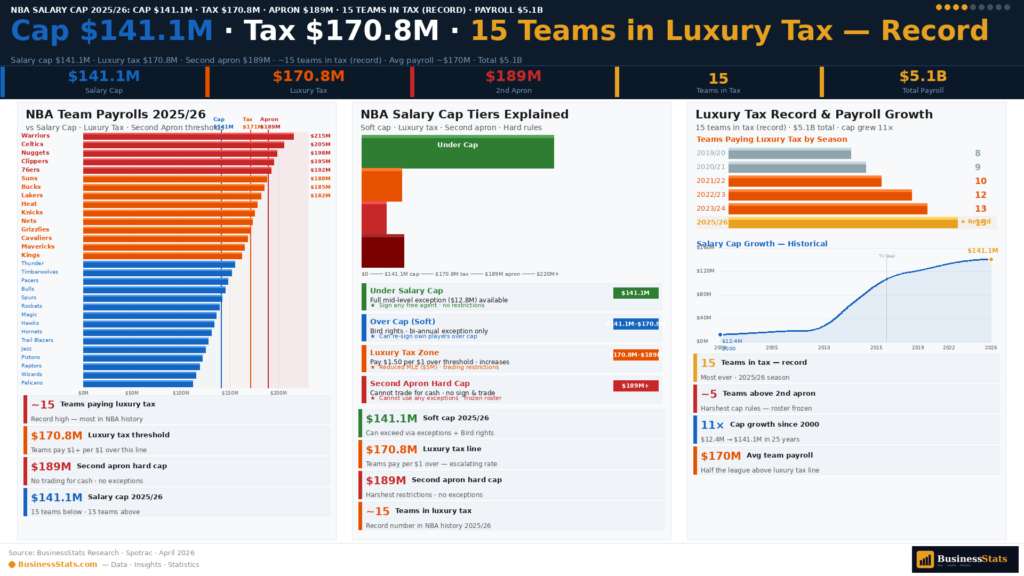
The 2025/26 NBA salary cap is $141.1 million per team — up from $136.0 million in 2024/25. The cap is set each July based on projected Basketball Related Income (BRI) from the prior season. Teams that exceed the cap pay a luxury tax — with a "soft" first tax threshold at $170.8 million and a "hard" second apron (new under the 2023 CBA) at approximately $189 million, above which teams face severe roster-building restrictions. The NBA's financial structure is comparable to other industries tracked in our U.S. financial markets analysis in terms of competitive balance mechanisms.
- Salary cap: $141.1M (2025/26) · up from $94.1M (2016/17) after TV deal spike
- Luxury tax threshold: $170.8M · teams above this pay per-dollar tax to the league
- Second apron (hard cap): ~$189M · new 2023 CBA · restricts trades, MLE, two-way contracts
- Max salary (0-6 yrs): 25% of cap = ~$35.3M
- Max salary (7-9 yrs): 30% of cap = ~$42.3M
- Max salary (10+ yrs / Supermax): 35-40% of cap = ~$49.4M–$56.4M
NBA Salary Cap Growth — Historical Trend 2010/11 to 2025/26
The line chart tracks the NBA salary cap from $58.0M (2010/11) to $141.1M (2025/26) — a 143% increase over 15 years. The dramatic 2016/17 spike (from $70M to $94M in one year) caused by the new national TV deal is clearly visible — and created the current era of massive max contracts.
NBA Team Payrolls — Highest Spending Teams 2025/26
Approximately 15 of 30 NBA teams are paying luxury tax in 2025/26 — a record high reflecting the new CBA's stricter provisions and the concentration of star players on big-market teams. The Golden State Warriors, carrying Curry ($55.76M), Klay Thompson's departure costs, and a deep roster, lead total payroll spending. The Phoenix Suns — with Durant, Booker, and additional pieces — are also among the highest spenders. The luxury tax dynamics connect to the broader wealth concentration in American sports tracked in our U.S. millionaires and wealth analysis. Player social media presence and marketability are analyzed in our Instagram statistics report and social media analysis.
- ~15 teams paying luxury tax in 2025/26 — record proportion of the league
- Second apron violators: Multiple teams at risk of hard cap penalties — new 2023 CBA enforcement era
- Largest market teams: LA Lakers, NY Knicks, Golden State consistently highest payrolls
- Total league payroll: ~$5.1B · average team payroll: ~$170M
- Revenue sharing: Small-market teams receive revenue sharing from luxury tax payments
NBA Average Salary Growth — 2010/11 to 2025/26
The grouped bar chart compares average NBA salary growth against the broader U.S. average income — illustrating just how dramatically NBA player compensation has grown relative to the overall economy. The NBA average salary ($11.2M in 2025/26) is approximately 188× the U.S. median household income (~$59,500).
NBA Salary Distribution — By Salary Tier 2025/26
The AUV bars below show how NBA player salaries are distributed across tiers. The majority of NBA players (~55%) earn between $2M and $10M — a range that includes veterans on mid-level exceptions and role players on team options. Only the elite top tier earns $30M+.
NBA Team Payroll Rankings — Top 10 Highest Spending Teams 2025/26
The rank bars show the top 10 highest-payroll NBA teams in 2025/26. Teams at or above the luxury tax threshold ($170.8M) pay escalating penalties — each dollar over the first threshold costs $1.50–$4.25+ in tax, depending on how far over they are. The NBA player stats analysis provides performance context for evaluating whether these high-payroll teams are generating returns on their salary investments.
NBA Salary Share by Position — 2025/26
The donut chart below shows how total NBA salary is distributed across positions. Guards (PG + SG) collectively earn the largest share — reflecting the premium placed on elite perimeter scorers and playmakers in the modern NBA. Centers have seen their salary share increase after years of decline, driven by dominant big men like Jokic and Embiid commanding supermax contracts.
Highest-Paid NBA Players — Key Statistics & Facts 2025/26
NBA Salary Trends & Outlook 2026–2030
The NBA's new national television deal — a landmark $76 billion, 11-year agreement with Amazon Prime Video, NBC, and ESPN beginning in 2025/26 — is the most important financial development in league history. The deal averages approximately $6.9 billion per year, nearly 3× the prior $2.6B/year TV deal. This revenue explosion will drive the salary cap to an estimated $155–160 million by 2026/27 and potentially $200 million by 2030. The implications for player salaries are dramatic: the current class of supermax players will be renegotiating or entering free agency at precisely the moment caps reach these new levels. The economic dynamics of this deal parallel the revenue growth patterns tracked in our global GDP and consumer spending analysis in terms of industry transformation scale.
- New TV deal: $76B over 11 years (2025/26–2035/36) · Amazon Prime Video + NBC + ESPN
- Annual TV revenue: ~$6.9B/yr — 2.65× the prior deal's $2.6B/yr
- 2026/27 cap estimate: $155–160M — another significant jump from $141.1M
- 2030 cap projection: ~$200M — first player could earn $70M+ in a single season
- Free agency class 2025: Giannis, Jokic (if he opts out), and others creating landmark decision moments
Key salary-related storylines to watch through 2030: Anthony Edwards will be eligible for a supermax extension worth approximately $65M/year by 2027/28 if he earns All-NBA. Shai Gilgeous-Alexander could similarly command $60M+ annually. The LeBron retirement question — will he play beyond 2025/26? — has significant cap implications for the Lakers. The emergence of young superstars through social media platforms is tracked in our YouTube market analysis and social media statistics, which show the NBA as the most digitally-engaged major sports league.
- Anthony Edwards supermax: ~$65M/year eligible by 2027/28 if All-NBA honors continue
- SGA supermax future: OKC could pay ~$60M/year to keep their franchise cornerstone
- Giannis 2025 FA: Will he re-sign with Milwaukee or move? Biggest free agency decision since KD 2016
- $70M salary barrier: First player to earn $70M in a single season likely by 2029/30
- Gen Z players: Chet Holmgren, Victor Wembanyama entering max contract territory by 2026/27
Frequently Asked Questions — Highest-Paid NBA Players 2025/26
Stephen Curry of the Golden State Warriors is the highest-paid NBA player in 2025/26 with a salary of $55,761,217 — the highest single-season salary in NBA history. This is the final year of the 4-year, $215.4 million supermax extension Curry signed in August 2021. His salary represents approximately 39.5% of the NBA salary cap — the maximum allowable for a player with 10+ years of service and supermax eligibility. At $679,771 per game, Curry earns more in a single game than most NBA players earn in an entire month.
The NBA salary cap for 2025/26 is $141.1 million per team — up from $136.0 million in 2024/25. The luxury tax threshold (where teams start paying penalties) is $170.8 million. A new "second apron" hard cap under the 2023 CBA sits at approximately $189 million, above which teams face severe roster restrictions. The cap is set annually based on approximately 50% of Basketball Related Income (BRI) — meaning as the NBA generates more revenue, the cap rises. The new $76 billion TV deal will accelerate cap growth significantly from 2025/26 onward.
Approximately 30 NBA players earn $30 million or more in the 2025/26 season. Of these: approximately 10 players earn $40 million or more, and 5 players earn $50 million or more (Curry, Jokic, Embiid, Durant, Tatum). The $30M+ club has exploded from just 3 players in 2016/17, reflecting the NBA salary cap growing from $70M to $141.1M during that period. For context, in 2010/11, only Kobe Bryant ($24.8M) earned over $20 million.
Stephen Curry's salary in 2025/26 is $55,761,217 — the highest single-season NBA salary ever. This is the final year of the 4-year, $215.4 million supermax extension signed with the Golden State Warriors in August 2021. Curry's career earnings in NBA salary alone have surpassed $350 million. Including endorsements (Under Armour, Chase, Rakuten, and others), his annual income is estimated at approximately $100–110 million total. After 2025/26, Curry will be a free agent — one of the most anticipated free agency decisions in league history.
Nikola Jokic's 2025/26 salary is $51,415,938 — tied for #2 with Joel Embiid. The 3-time MVP signed a 5-year, $264 million supermax extension with the Denver Nuggets in August 2022, averaging approximately $52.8 million annually with annual increases. Jokic is widely considered the greatest value contract in NBA history given his transcendent statistical production (averaging 26+ points, 13+ rebounds, 9+ assists in recent seasons) and the fact that the Nuggets won the 2023 NBA Championship with him as the undisputed best player in the world.
LeBron James' salary in 2025/26 is $48,743,826 — making him the 8th highest-paid player in the league at age 41. He signed a 2-year, $97.1 million extension with the Los Angeles Lakers in 2023, keeping him in LA. LeBron's total guaranteed NBA career salary has surpassed $500 million — the first player in league history to reach that milestone. In 2025/26, he plays alongside his son Bronny James (also on the Lakers), making them the first father-son duo to play together in NBA history. LeBron is also the oldest top-10 salary earner in league history.
The maximum NBA salary in 2025/26 depends on years of experience: 0–6 years of service: up to 25% of the salary cap = ~$35.3M. 7–9 years of service: up to 30% of cap = ~$42.3M. 10+ years of service (standard max): up to 35% of cap = ~$49.4M. Supermax (Designated Player Extension): up to 35–40% of cap = ~$49.4M–$56.4M. Supermax eligibility requires the player to have been named to All-NBA, won MVP, or been named Defensive Player of the Year in a prior season while with their current team.
Giannis Antetokounmpo's salary in 2025/26 is $48,743,826 with the Milwaukee Bucks — the final year of the 5-year, $228.2 million supermax extension he signed in 2020. After 2025/26, Giannis becomes one of the most significant free agents in NBA history. The 2-time MVP and 2021 NBA champion will have every major market team pursuing him. His decision — whether to re-sign with Milwaukee or pursue another championship with a different franchise — is considered the most consequential NBA free agency decision since Kevin Durant left Oklahoma City in 2016.
NBA players earn significantly more per player than any other major professional sports league. NBA average salary: $11.2M (2025/26). MLB average: ~$4.7M (2025). NHL average: ~$2.4M. NFL average: ~$3.9M. MLS average: ~$520K. The NBA's higher per-player average reflects its relatively small roster sizes (15 players vs NFL's 53-man active roster), its global brand premium, and the 2023 CBA's favorable revenue-sharing structure for players. The new $76B TV deal will further increase NBA per-player compensation versus other leagues.
Anthony Edwards' salary in 2025/26 is approximately $43,892,000 with the Minnesota Timberwolves, reflecting his 5-year maximum rookie extension signed in 2023. At 24 years old in 2025/26, Edwards has established himself as one of the NBA's premier young stars and the face of the Timberwolves franchise. He averaged 27+ points per game in 2024/25 and has become one of the most marketable players in the league — with endorsements from Adidas, Bose, and others adding significantly to his basketball earnings. Edwards will be eligible for a supermax extension worth potentially $65M+ annually by 2027/28 if he earns All-NBA honors.
NBA rookie salaries are governed by the CBA rookie scale for first-round picks, which sets guaranteed 2-year salaries with 2 team option years. For 2025/26: the #1 overall pick earns approximately $10.5–11M in year 1; #5 pick earns approximately $8.1M; #10 pick earns approximately $6.5M; #15 pick earns approximately $4.9M; #30 pick earns approximately $2.1M. Second-round picks and undrafted players can be signed for the rookie minimum (~$1.19M). After 4 years on a rookie contract, top players become eligible for maximum rookie extensions — which is how players like Anthony Edwards ($43.9M), Shai Gilgeous-Alexander ($40M), and Ja Morant ($40.4M) came to earn such large salaries relatively early in their careers.
Luka Doncic's salary in 2025/26 is $46,574,216 with the Los Angeles Lakers — the team he joined in a blockbuster trade from the Dallas Mavericks in early 2025. The Slovenian superstar signed a 5-year, $215 million supermax extension with Dallas in 2022 before the trade. In Los Angeles, Doncic joins a franchise with unmatched global marketing reach — his move to LA is expected to generate significant commercial and broadcast value. Doncic averaged 29.3 points, 9.0 rebounds, and 8.7 assists per game in 2024/25, making him one of the top 3 players in the world by most metrics.
The NBA average salary has grown dramatically over 15 years: 2010/11: $4.9M → 2025/26: $11.2M — a 129% increase. The growth has been driven primarily by NBA revenue expanding from $3.8 billion (2010) to approximately $12 billion (2025/26) — a 216% revenue increase. Key milestones: the 2016/17 season saw the cap spike from $70M to $94M after the $24B ESPN/TNT TV deal, creating a single-year jump in average salaries. The new 2025/26 TV deal ($76B over 11 years with Amazon, NBC, ESPN) will drive average salaries from $11.2M toward an estimated $14M+ by 2029/30.
The Golden State Warriors are among the highest-payroll teams in 2025/26, carrying Curry ($55.76M) plus other veteran contracts. The Phoenix Suns (Durant $51.2M + Booker $49.3M) and Boston Celtics (Tatum $50.2M + Brown $49.6M) are also among the highest-spending teams. Approximately 15 of 30 NBA teams are paying luxury tax in 2025/26 — a record proportion. Under the new 2023 CBA, teams above the "second apron" (~$189M) face severe roster restrictions, including prohibition from signing mid-level exception free agents and restrictions on trade aggregation.
The NBA's new $76 billion, 11-year TV deal (2025/26 through 2035/36) with Amazon Prime Video, NBC, and ESPN will dramatically increase player salaries. The deal averages approximately $6.9 billion per year — nearly 3× the prior $2.6B/year deal. As the salary cap is tied to ~50% of Basketball Related Income (BRI), it will rise significantly: the cap is projected to reach approximately $155–160M in 2026/27, and potentially $200M+ by 2030/31. This means the first player to earn $70M+ in a single season could occur as early as 2028/29. Young superstars like Anthony Edwards and Victor Wembanyama stand to benefit most from this cap explosion.
Primary: Spotrac NBA Contracts — Player contracts, team payrolls, luxury tax tracker, cap space analysis
Primary: Basketball-Reference — NBA Player Salary Data, Historical Salary Tables, Contract Terms
Supporting: ESPN NBA Salaries — Player salary rankings, team breakdowns, cap analysis 2025/26
Supporting: NBA.com / Stats.NBA.com — Official NBA statistics, salary cap announcements, CBA documentation