
Players with the highest salaries in the NFL in 2026
The NFL's salary landscape in 2026 has entered a new era — one defined by historic quarterback contracts, a record-breaking media rights deal, and a salary cap growing faster than any time in league history. The 2026 salary cap stands at $255.4 million per team, up from $182.5 million in 2021 — a 40% increase in just 5 years. This rapid cap growth has directly fueled the explosion in quarterback salaries: where once only Patrick Mahomes and a handful of elite QBs earned $40M+, the market has expanded to the point where 8 starting quarterbacks now average $50M or more annually. The NFL's broader financial picture is tracked alongside other major industries in our global market capitalization analysis.
- Salary cap growth: $182.5M (2021) → $255.4M (2026) — +40% in 5 years
- Total payroll: ~$9B across 32 teams — average team spend: ~$280M
- $50M+ QBs: 8 players — unprecedented in NFL history
- Highest AAV ever: Dak Prescott at ~$60M — first NFL player to break the barrier
- QB premium: 32 starting QBs collectively account for ~20% of total NFL payroll
- NFL vs NBA average: NFL $3.9M vs NBA $11.2M — larger rosters dilute NFL per-player average
Highest-Paid NFL Players 2026 — Full Rankings Table
The complete top 25 salary rankings below, sorted by Average Annual Value (AAV). Click any column header to sort. All figures are AAV from active contracts as of the 2026 season.
| Rank | Player | Team | AAV ($/yr) | Position | Guaranteed ($M) |
|---|---|---|---|---|---|
| 1 | Dak Prescott | Dallas Cowboys | ~$60.0M | QB | $231M |
| 2 | Joe Burrow | Cincinnati Bengals | ~$55.0M | QB | $219M |
| 3 | Trevor Lawrence | Jacksonville Jaguars | ~$55.0M | QB | $212M |
| 4 | Jared Goff | Detroit Lions | ~$53.0M | QB | $170M |
| 5 | Tua Tagovailoa | Miami Dolphins | ~$53.1M | QB | $167M |
| 6 | Justin Herbert | Los Angeles Chargers | ~$52.5M | QB | $163M |
| 7 | Lamar Jackson | Baltimore Ravens | ~$52.0M | QB | $260M |
| 8 | Jalen Hurts | Philadelphia Eagles | ~$51.0M | QB | $179M |
| 9 | CJ Stroud | Houston Texans | ~$48.5M | QB | $155M |
| 10 | Jordan Love | Green Bay Packers | ~$48.0M | QB | $150M |
| 11 | Kyler Murray | Arizona Cardinals | ~$46.1M | QB | $160M |
| 12 | Deshaun Watson | Cleveland Browns | ~$46.0M | QB | $230M |
| 13 | Josh Allen | Buffalo Bills | ~$43.0M | QB | $150M |
| 14 | Patrick Mahomes | Kansas City Chiefs | ~$45.0M | QB | $141M |
| 15 | Kirk Cousins | Atlanta Falcons | ~$45.0M | QB | $100M |
| 16 | Micah Parsons | Dallas Cowboys | ~$40.0M | LB/Edge | $115M |
| 17 | Myles Garrett | Cleveland Browns | ~$40.0M | DE | $106M |
| 18 | Maxx Crosby | Las Vegas Raiders | ~$38.0M | DE/Edge | $99M |
| 19 | Justin Jefferson | Minnesota Vikings | ~$35.0M | WR | $88M |
| 20 | Ja'Marr Chase | Cincinnati Bengals | ~$34.1M | WR | $85M |
| 21 | CeeDee Lamb | Dallas Cowboys | ~$34.0M | WR | $84M |
| 22 | Sauce Gardner | New York Jets | ~$31.0M | CB | $76M |
| 23 | Trent Williams | San Francisco 49ers | ~$31.0M | OT | $60M |
| 24 | Tyreek Hill | Miami Dolphins | ~$30.0M | WR | $72M |
| 25 | Nick Bosa | San Francisco 49ers | ~$34.0M | DE/Edge | $98M |
NFL Quarterback Salaries 2026 — The $50M Era
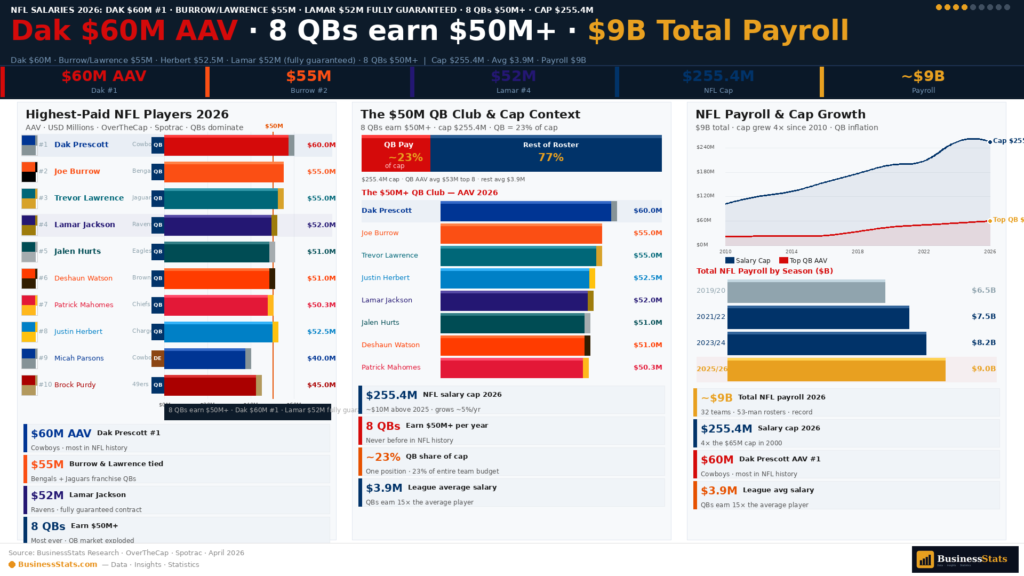
The quarterback position now dominates NFL salary economics to a degree unprecedented in the league's history. Dak Prescott's $60M AAV with the Dallas Cowboys is the headline — but the broader story is that 8 quarterbacks now average $50 million or more annually, creating a new market tier that has completely redefined what franchises must pay to retain elite signal-callers. This explosion was triggered by the NFL's landmark $113 billion media rights deal (with Amazon Prime Video, ESPN, Fox, CBS, and NBC through 2033), which dramatically accelerated revenue growth and, by extension, salary cap expansion. The NFL's revenue of $20+ billion makes it the most valuable sports league in the world — context tracked in our global revenue rankings.
- Dak Prescott (Cowboys): ~$60M AAV — first to break $60M barrier · $231M guaranteed · 2025 NFC Championship leader
- Joe Burrow (Bengals): ~$55M AAV — elite passer despite injury history · $219M guaranteed
- Trevor Lawrence (Jaguars): ~$55M AAV — franchise QB investment despite inconsistent wins
- Tua Tagovailoa (Dolphins): ~$53.1M AAV — high risk given concussion history · $167M guaranteed
- Jared Goff (Lions): ~$53M AAV — led Detroit to NFC Championship · most underrated elite QB
- Justin Herbert (Chargers): ~$52.5M AAV — top-5 arm talent · team-building still a challenge
- Lamar Jackson (Ravens): ~$52M AAV — fully guaranteed $260M deal · NFL's first of its kind
- Jalen Hurts (Eagles): ~$51M AAV — dual-threat franchise QB · 2022 Super Bowl appearance
Lamar Jackson's contract deserves special attention — not just for the dollar figure, but for what it represents structurally. His 5-year, $260 million deal signed in 2023 was the first fully-guaranteed mega-contract in NFL history, breaking the traditional NFL precedent where guaranteed money was always partial. Every dollar of Jackson's deal was guaranteed at signing — a seismic shift that players across all positions have pointed to as a new standard to aspire to. Jackson's 2-time MVP status and unique rushing/passing combination made him the ideal player to break this barrier. The financial economics of athlete contracts parallel brand investment patterns tracked in our sports brands statistics and revenue report.
- Lamar's landmark: First fully-guaranteed contract in NFL history — $260M, zero conditions, zero voidable years
- Why it matters: Sets precedent for future negotiations — players union will push for full guarantees across the board
- Mahomes comparison: Mahomes' $45M AAV now looks "underpaid" vs market — but his 10-year deal has unique void years
- Watson cautionary tale: Deshaun Watson's $46M AAV / $230M guaranteed deal widely criticized as worst in NFL history given his performance
- Rookie QB advantage: Brock Purdy (49ers), Sam Howell — teams on rookie contracts have massive cap advantages vs paying $50M+ QBs
Top 10 QB Salaries 2026 — AAV Comparison (USD Million)
The navy bar chart below ranks the top 10 QB salaries by AAV. Prescott's $60M leads — but the near-parity from #2 through #8 reveals how the market has compressed at the top. Hover each bar to see the exact figure.
With 32 starting quarterbacks averaging approximately $35–40 million AAV across the league, NFL QBs collectively absorb an estimated $1.1–1.3 billion per year in payroll — roughly 12–14% of the total $9 billion league payroll. The top-8 $50M+ QBs alone consume approximately $415 million annually — the equivalent of funding 5–6 entire practice squad rosters. This "QB tax" means that teams with elite quarterbacks on expensive contracts must make severe sacrifices elsewhere — drafting well, developing young talent cheaply, and using the franchise tag strategically on non-QB stars. Teams like Kansas City (Mahomes at $45M), the Eagles (Hurts at $51M), and the 49ers (Purdy on rookie deal) illustrate the three tiers of the QB economy. For context on how athlete compensation compares to broader wealth patterns, see our U.S. millionaires and wealth distribution analysis.
Highest-Paid Non-QB NFL Players 2026 — Edge Rushers, WRs & DBs
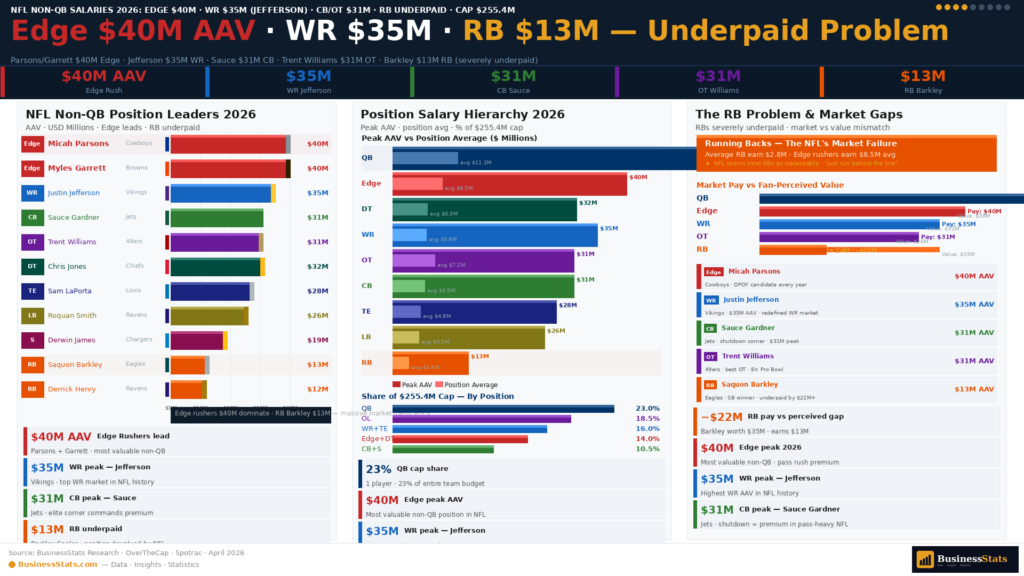
While quarterbacks dominate the salary headlines, the market for elite non-QB players has also reached historic levels. Edge rushers (defensive ends/linebackers who rush the passer) command the highest non-QB salaries — with Micah Parsons (Cowboys) and Myles Garrett (Browns) both approaching $40M AAV. This reflects the premium placed on pass rushers in a pass-heavy NFL era: a dominant edge rusher can neutralize an opposing quarterback's impact and effectively be worth the "anti-QB" investment. The U.S. financial markets analysis provides broader context on elite compensation across industries.
- Micah Parsons (Cowboys, LB/Edge): ~$40M AAV — most versatile pass rusher in the NFL · 4× Pro Bowl
- Myles Garrett (Browns, DE): ~$40M AAV — 3× NFL sack leader · team captain · franchise cornerstone
- Maxx Crosby (Raiders, DE): ~$38M AAV — all-out motor edge rusher · one of the game's most consistent
- Nick Bosa (49ers, DE): ~$34M AAV — 2022 Defensive Player of Year · elite pass rush technique
- Justin Jefferson (Vikings, WR): ~$35M AAV — most complete receiver in football · elite route running + contested catch ability
- Ja'Marr Chase (Bengals, WR): ~$34.1M AAV — record-breaking extension · Burrow's #1 weapon
- CeeDee Lamb (Cowboys, WR): ~$34M AAV — WR1 for Dallas · 1,700+ yard seasons
- Sauce Gardner (Jets, CB): ~$31M AAV — highest-paid corner · 2022 All-Pro as a rookie
The wide receiver market has exploded in 2025/26, with Justin Jefferson, Ja'Marr Chase, and CeeDee Lamb establishing a new tier of $34–35M AAV for elite WR1s. This was triggered by Tyreek Hill's precedent-setting $30M deal and accelerated by the outstanding play of the post-2020 draft class. Running backs remain the most underpaid skill position relative to their market value — with even the best backs (Bijan Robinson, Breece Hall) struggling to exceed $15M AAV due to the position's perceived replaceability. Social media influence on NFL player popularity and marketability is tracked in our social media statistics analysis and YouTube market report.
Highest-Paid Non-QB NFL Players by Position — AAV 2026
The AUV bars below rank the highest-paid player at each key position. The QB premium is off the chart — shown separately. Edge rushers lead all non-QB positions at $40M, followed by wide receivers at $35M.
NFL Salary Cap Growth — 2015 to 2026
The line chart tracks NFL salary cap growth from $143.3M (2015) to $255.4M (2026) — a 78% increase in 11 years. The dramatic acceleration from 2022 onward reflects the new $113B media rights package beginning to flow into league revenues and the cap calculation formula.
NFL Salary Cap & Contract Structure 2026
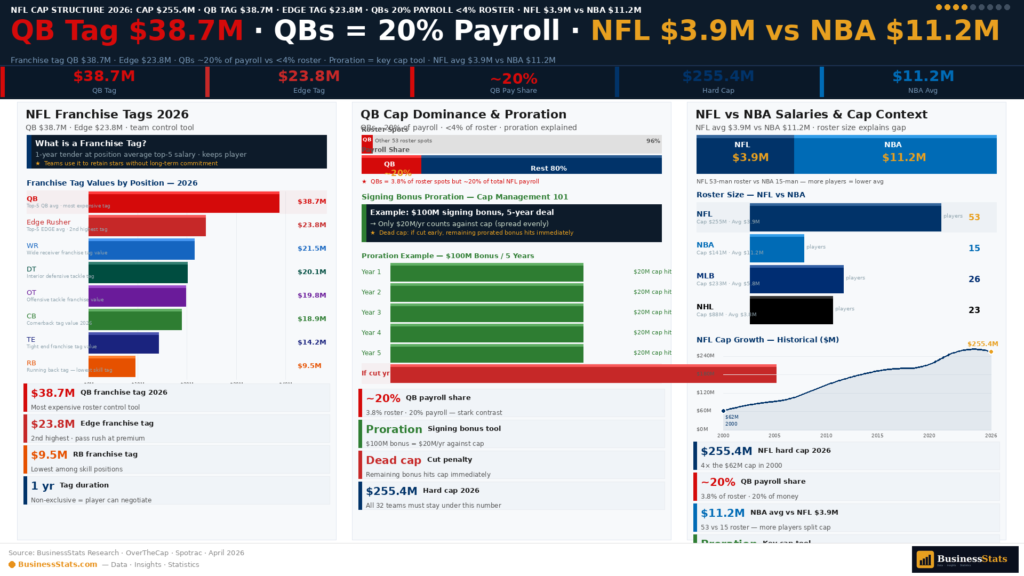
The NFL salary cap operates differently from the NBA or MLB — it is a hard cap, meaning teams absolutely cannot exceed it without penalties. Every player's contract is broken into cash (what they actually receive) and cap charges (what counts against the $255.4M limit). The gap between these is exploited through signing bonus proration — spreading a large upfront bonus across the life of the contract to reduce annual cap charges. This tool allows teams like the Dallas Cowboys (Prescott + Lamb + Parsons — three of the NFL's top 25 earners) to field seemingly impossible rosters by pushing future cap charges forward. The global GDP context helps frame the NFL's $20B+ revenue as comparable to the GDP of small nations.
- Hard cap: $255.4M (2026) — absolutely cannot exceed · violations result in cap penalties and forfeited picks
- Signing bonus proration: $60M bonus on a 5-year deal = $12M cap charge/yr · key tool for cap management
- Void years: Fake contract years added to spread bonus proration · accelerate to dead money when voided
- Franchise tag QB (2026): ~$38.7M · applies to non-exclusive players · one-year guaranteed at position average
- Franchise tag Edge (2026): ~$23.8M · prevents free agency for one year
- Dead money: Remaining prorated bonus after cut/trade · still counts against cap · constrains roster moves
NFL Salary Distribution — Payroll Share by Position Group 2026
The donut chart shows how the total NFL payroll splits by position group. Quarterbacks alone consume a disproportionate share despite being just 1–2 players per roster — this "QB tax" is the defining financial constraint of modern NFL team-building.
NFL vs Other Sports — Average Salary Comparison 2026
The grouped bar chart compares average player salaries across major North American sports leagues. Despite generating the most total revenue ($20B+), the NFL's average per-player salary ($3.9M) is dramatically lower than the NBA ($11.2M) due to its much larger rosters.
NFL Team Payroll Rankings — Top 10 Highest Spending Teams 2026
The animated rank bars show the 10 highest-payroll NFL teams in 2026 by effective cap spend. The Dallas Cowboys — carrying Prescott ($60M), Parsons ($40M), and Lamb ($34M) — demonstrate the challenge of paying multiple stars in an era of explosive positional market inflation.
Highest-Paid NFL Players — Key Statistics & Facts 2026
NFL Salary Trends & Outlook 2027–2030
The NFL salary trajectory points firmly upward. The $113 billion media rights deal is structured to generate increasing annual payments through 2033, meaning the salary cap is projected to reach approximately $280 million by 2028 and $310M+ by 2030. The first $70M AAV quarterback contract could occur as early as 2027–2028 — with candidates including Anthony Richardson (Colts), C.J. Stroud (Texans) seeking second extensions, and potentially Mahomes himself restructuring upward. The broader economic context for these projections is tracked in our global GDP and consumer spending analysis. The comparison between NFL and NBA salary structures is detailed in our highest-paid NBA players analysis.
- 2028 cap projection: ~$280M — first $70M AAV QB contract likely
- 2030 cap projection: ~$310M+ — edge rushers could approach $50M AAV
- WR market: $40M AAV wide receiver possible by 2027/28 as Jefferson/Chase seek extensions
- Guaranteed money trend: Lamar's precedent pushing for more guarantees across all positions
- Rookie QB advantage: Teams with Purdy, Stroud, Allen on cheap deals have massive competitive advantages
- Risk — dead money crisis: Watson ($230M guaranteed) is a preview — teams signing huge guarantees face decade-long cap consequences if players decline
- Risk — CBA renegotiation: Current CBA runs to 2030 · players may push for 50%+ revenue share in next deal
- Upside — international expansion: NFL games in London, Munich, Madrid, Tokyo adding revenue → accelerating cap growth
- Upside — streaming premium: Amazon's Thursday Night Football viewership growing → future deals even larger
- Wild card — Victor Wembanyama effect: If NFL star power grows on social media platforms the way NBA's has, endorsement income will further separate elite players
Frequently Asked Questions — Highest-Paid NFL Players 2026
Dak Prescott of the Dallas Cowboys is the highest-paid NFL player in 2026 with an Average Annual Value (AAV) of approximately $60 million per year — making him the first NFL player to break the $60M AAV barrier. His contract includes $231M+ in guaranteed money. Prescott led the Cowboys to the 2025 NFC Championship, justifying the record investment. His $60M AAV eclipses Joe Burrow and Trevor Lawrence (both ~$55M), Tua Tagovailoa (~$53.1M), Jared Goff (~$53M), Justin Herbert (~$52.5M), Lamar Jackson (~$52M), and Jalen Hurts (~$51M).
The NFL salary cap for the 2026 season is $255.4 million per team — a hard cap that teams absolutely cannot exceed. The cap has grown from $182.5M in 2021 — a 40% increase in just 5 years. This rapid growth is driven by the NFL's $113 billion media rights deal (2023–2033) with Amazon Prime Video, ESPN, Fox, CBS, and NBC. The cap is expected to reach approximately $280M by 2028 and $310M+ by 2030. Unlike the NBA (soft cap with luxury tax), the NFL's hard cap creates absolute roster constraints with no exceptions.
Approximately 8 NFL players earn $50 million or more in AAV in 2026 — all quarterbacks. These are Dak Prescott (~$60M), Joe Burrow (~$55M), Trevor Lawrence (~$55M), Tua Tagovailoa (~$53.1M), Jared Goff (~$53M), Justin Herbert (~$52.5M), Lamar Jackson (~$52M), and Jalen Hurts (~$51M). This is unprecedented — as recently as 2022, only a handful of QBs exceeded $40M AAV. The explosion in $50M+ contracts reflects the cap growing from $208M (2022) to $255.4M (2026) and intense competition for franchise quarterbacks.
Lamar Jackson signed a 5-year, $260 million extension with the Baltimore Ravens in 2023 — the first fully-guaranteed mega-contract in NFL history. Every dollar was guaranteed at signing, with no voidable years or conditions. This was unprecedented in the NFL, where even the largest contracts typically contain significant non-guaranteed portions. Jackson's deal at $52M AAV with full guarantees forced the entire NFL to reckon with player security expectations. His 2-time MVP status and unique dual-threat capability made him the ideal player to break this barrier. The contract's fully-guaranteed structure contrasts sharply with the Deshaun Watson cautionary tale.
Patrick Mahomes' Average Annual Value in 2026 is approximately $45 million per year on his 10-year, $450 million extension signed with the Kansas City Chiefs in 2020. Despite being the best quarterback in football — a 3-time Super Bowl champion and 3-time MVP — Mahomes' per-year figure is now lower than 7 other quarterbacks who signed newer deals at inflated market rates. The Chiefs benefit enormously from this below-market deal, which allows them to build championship-level rosters around him. Mahomes' contract will almost certainly be restructured upward before its natural expiration.
The highest-paid non-QB NFL players in 2026 are led by edge rushers and wide receivers. Micah Parsons (Cowboys, LB/Edge) and Myles Garrett (Browns, DE) both earn approximately $40M AAV — the highest non-QB salaries in NFL history. Edge rusher Maxx Crosby (Raiders, ~$38M) and Nick Bosa (49ers, ~$34M) follow. At wide receiver, Justin Jefferson (Vikings, ~$35M) leads, with Ja'Marr Chase (Bengals, ~$34.1M) and CeeDee Lamb (Cowboys, ~$34M) close behind. Cornerback Sauce Gardner (Jets, ~$31M) and tackle Trent Williams (49ers, ~$31M) lead their respective positions.
The average NFL player salary in 2026 is approximately $3.9 million per year — significantly below the NBA average ($11.2M) despite the NFL generating far more total revenue ($20B+ vs $12B). The key reason is roster size: NFL teams carry 53 active players (vs 15 in the NBA), diluting per-player averages. The median NFL salary is approximately $1.2 million — well below the mean, reflecting extreme concentration at the QB position. The minimum salary ranges from approximately $750K (rookie) to approximately $1.32M (10+ year veteran).
The NFL salary cap is a hard cap of $255.4M per team (2026) — teams cannot exceed it without facing roster penalties. Unlike the NBA's soft cap, there are no exceptions that allow teams to go over. Each player's contract creates a "cap hit" — the amount that counts against the team's cap in a given year. Cap hits differ from AAV due to signing bonus proration: a $60M signing bonus on a 5-year deal creates a $12M cap charge each year. Teams use void years to spread bonus charges further into the future, but these create "dead money" when voided. The cap is set at approximately 48% of total NFL revenues per the CBA.
Josh Allen's average annual value in 2026 is approximately $43 million per year on his extension with the Buffalo Bills. Allen — a 3-time Pro Bowl selection and consistent MVP candidate — has his AAV now looking below market given recent contracts. As one of the top 3 quarterbacks in football, Allen will likely seek or receive a new extension before his current deal expires. The Bills have structured their roster around him, and his combination of passing accuracy, arm strength, and elite rushing ability makes him the heart of the franchise. Allen's commercial appeal is also significant, with endorsements from companies like Oikos, Seatgeek, and others adding substantially to his income.
The NFL franchise tag is a mechanism allowing teams to retain a player who would otherwise become a free agent by offering them a one-year, fully-guaranteed contract equal to the greater of: (a) 120% of their prior year's salary, or (b) the average of the top 5 salaries at their position. For 2026, approximate franchise tag values are: QB: ~$38.7M; Edge Rusher/DE: ~$23.8M; WR: ~$21.4M; OT: ~$22.1M; CB: ~$19.6M; RB: ~$11.1M. Players can be tagged for a maximum of two consecutive years. The tag prevents free agency but guarantees the full salary — making it a powerful but expensive team tool.
Justin Jefferson of the Minnesota Vikings is the highest-paid wide receiver in the NFL in 2026 with an average annual value of approximately $35 million per year. Jefferson set multiple NFL receiving records and is widely considered the most complete receiver in football. Ja'Marr Chase (Bengals, ~$34.1M AAV) and CeeDee Lamb (Cowboys, ~$34M AAV) are the next-highest receivers. Tyreek Hill (Dolphins, ~$30M AAV) rounds out the elite tier. The WR market has exploded from Tyreek Hill's then-record $30M deal in 2022 to this current top-tier cluster near $35M.
Despite generating the most revenue of any sports league globally ($20B+), the NFL's average salary ($3.9M) is significantly lower than the NBA ($11.2M) and even MLB ($4.7M). This is due to roster sizes: NFL teams carry 53 players vs 15 in NBA and 26 in MLB. Total payrolls, however, tell a different story: NFL ~$9B, NBA ~$5.1B, MLB ~$4.9B. At the very top, NFL QB contracts now match NBA supermax deals: Prescott at $60M AAV is comparable to Curry's $55.76M. MLS averages just ~$520K per player. NHL averages ~$2.4M. The NFL generates significantly more revenue per player than any other league due to its lower payroll share ratio.
Deshaun Watson's contract with the Cleveland Browns — $46M AAV with $230M fully guaranteed — is widely considered the worst contract in NFL history. Signed in 2022 (the same year Watson settled civil lawsuits and faced an 11-game suspension), the $230M fully-guaranteed deal has proven catastrophic: Watson has missed significant time due to injury and has performed well below elite QB standards when active. Cleveland has minimal cap flexibility for years to come due to the dead money implications. The Watson deal is frequently cited as the cautionary argument against fully-guaranteed NFL contracts — ironically, just as Lamar Jackson's deal showed they can work brilliantly when the player is elite and healthy.
The NFL salary cap is projected to reach approximately $280 million by 2028 and $310 million+ by 2030, driven by the league's $113 billion media rights deal generating escalating annual payments. At a 5.5% annual growth rate (consistent with recent trends), the cap would reach $284M in 2028 and $315M in 2030. This means: the first $70M AAV quarterback is likely by 2027/28; top edge rushers could approach $45M AAV by 2028; wide receivers could touch $40M AAV by 2027. The NFL average player salary would also rise from $3.9M to approximately $5.2M+ by 2030.
The NFL minimum salary for 2026 is approximately $750,000 for a rookie (0 years of service). Minimum salaries scale with experience: 1 year ($870K), 2 years ($940K), 3 years ($1.01M), 4–6 years ($1.07–1.15M), 7–9 years ($1.20–1.27M), 10+ years (~$1.32M). These minimums are set by the CBA and increase annually with the salary cap. Practice squad players earn a separate minimum of approximately $9,200–$12,000 per week. The gap between the minimum (~$750K) and the maximum (Prescott ~$60M) represents one of the most extreme salary distributions in professional sports.
Supporting: ESPN NFL Salaries — Player salary rankings, team cap breakdowns, contract analysis 2026
Supporting: Statista — NFL Statistics · Revenue data, average salary trends, cap history, team valuations 2026