
Armed forces of the United States — the world's largest military budget and most globally deployed force in 2026
The United States Armed Forces are the most powerful and most expensive military in human history. Six branches, Army, Navy, Air Force, Marine Corps, Coast Guard, and Space Force, combine for 1.3 million active duty service members as of October 2025, supported by 750,000 reserve and National Guard personnel. The total DoD workforce including 701,000 civilian employees reaches 2.86 million people, larger than the population of Chicago. The FY2026 defense budget request of $961.6 billion is the largest in US history, reflecting simultaneous operational demands including Operation Epic Fury against Iran, Indo-Pacific deterrence commitments, and nuclear triad modernization. The US accounts for approximately 32 percent of all global military spending ($2.9 trillion total worldwide), and operates approximately 800 military installations globally. The US financial market context driving defense investment is in our U.S. financial markets analysis.
The strategic rationale for US military spending rests on three pillars: deterrence against state-level adversaries (China, Russia, North Korea, and Iran), power projection to protect global trade routes and alliance commitments, and the maintenance of the rules-based international order underwritten by US military guarantees since 1945. In 2025-2026, all three pillars are under simultaneous stress, contributing to the historic 13 percent jump in the FY2026 budget request. Operation Epic Fury, the joint US-Israel military campaign against Iran that began February 28, 2026, cost over $11.3 billion in the first six days alone per Pentagon testimony to Congress. Full casualty data from that conflict is in our Iran war 2026 casualties analysis.
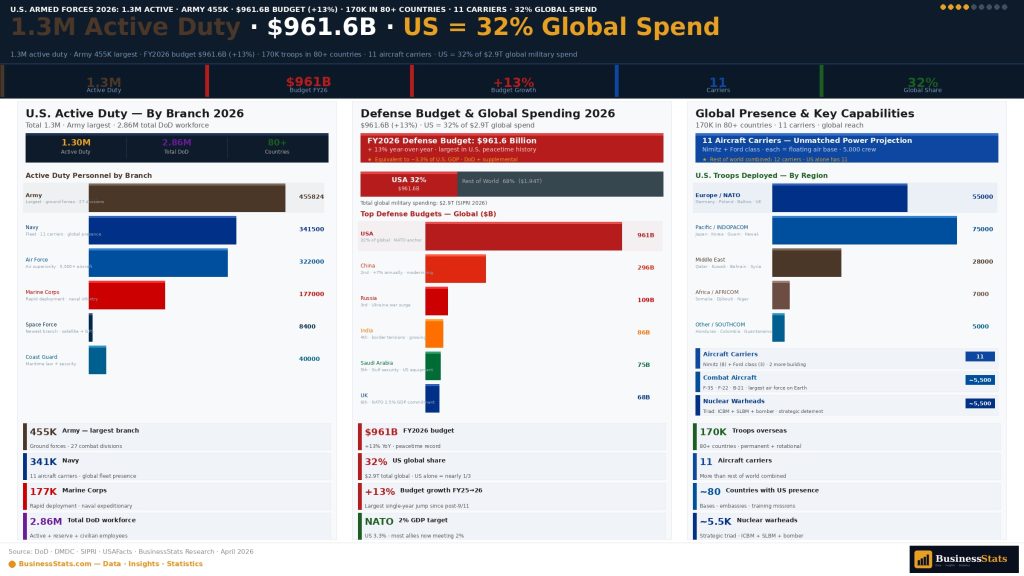
- Active duty: ~1.3M across six branches · Grew 1.5% March 2024-March 2025, reversing years of decline · All branches hit FY2025 recruiting goals
- Total force: ~2.1M uniformed personnel (active + reserve + National Guard) · 701,000 civilian DoD employees = 2.86M total workforce
- FY2026 budget: $961.6B — largest in US history · 13% jump over FY2025 · $600B total military compensation including veterans benefits (up 162% since 1980 in real terms)
- Global presence: ~170,000 troops in ~80 countries · ~800 military installations globally · 11 aircraft carriers · US Special Operations Command active on 6 continents
- Nuclear deterrent: ~5,550 total nuclear warheads · ~1,700 deployed on ICBM + SLBM + strategic bomber triad · $1.7T modernization program over 30 years
U.S. Military — Active Duty Personnel by Branch, October 2025
The U.S. Army is the largest military branch with 455,824 active duty soldiers as of October 31, 2025, the most recent confirmed DMDC data. It accounts for 34 percent of all active duty troops and 65 percent of all reservists. The Army hit its FY2025 recruiting target of 61,000 new soldiers months ahead of schedule, a remarkable turnaround from its 2022-2023 crisis when it fell approximately 10,000 soldiers short of its annual goal. The Navy (341,496) and Air Force (318,983) follow. The Space Force, established December 2019 as the first new branch since the Air Force in 1947, has approximately 10,000 Guardians and has already surpassed its FY2026 recruiting goals. Its top enlisted leader has publicly called for the branch to double in size to 20,000 to meet growing national security space demands. The global company valuations context is in our world's most valuable companies analysis.
| Branch | Active Duty | Guard/Reserve | FY2026 Budget | Key Notes 2026 |
|---|---|---|---|---|
| U.S. Army | 455,824 | ~510,000 | $197.4B | Largest branch · Hit 61,000 FY2025 recruits ahead of schedule |
| U.S. Navy | 341,496 | ~57,000 | $292.2B | 2 carrier strike groups in Middle East (Op. Epic Fury) |
| U.S. Air Force | 318,983 | ~177,000 | $301.1B | Largest FY2026 appropriation · B-2 bombers struck Iran 2026 |
| Marine Corps | ~177,000 | ~33,000 | Incl. Navy | Force Design 2030 · Anti-ship missiles · Unmanned systems |
| Coast Guard | ~40,800 | ~7,000 | ~$13.7B | DHS in peacetime · Caribbean counter-narcotics operations |
| Space Force | ~10,000 | — | ~$29.4B | Newest branch (2019) · Surpassed FY2026 goals · Target: 20,000 |
| Total | ~1.3M | ~784,000 | $961.6B | + 701,000 civilian employees = 2.86M total DoD workforce |
National Guard 433,990 Members — Reserve Forces Bring Total to 2.1 Million
The reserve and National Guard components are a deployable, operational part of total US military force. The National Guard has 433,990 members as of September 2025, with 97 percent residing in the US. The Army National Guard contributes approximately 330,000 personnel with a dual state-federal mission, deployable for domestic emergencies and overseas operations. From June to December 2025, the Trump administration deployed National Guard personnel to six US cities for immigration enforcement, costing an estimated $496 million per CBO analysis. Reserve members bring specialized civilian skills, cybersecurity, AI engineering, healthcare, and logistics, that are increasingly critical in modern operations. The investment context driving defense industry growth is in our investment banking revenue analysis.
FY2026 Defense Budget — $961.6 Billion, 13% Jump, Largest in US History
The FY2026 defense budget request of $961.6 billion is one of the largest single-year defense budget jumps in American history. The Air Force receives $301.1 billion, the largest single branch appropriation, funding B-2 Spirit bombers used in Operation Epic Fury, F-35 fleet operations, and next-generation air dominance programs. The Navy receives $292.2 billion, reflecting two simultaneously deployed carrier strike groups in the Middle East plus Indo-Pacific deterrence commitments. Shipbuilding alone: $33.4 billion, including 2 Virginia-class attack submarines ($8.2B) and 2 Arleigh Burke-class destroyers ($5.4B). The Army's $197.4 billion, the smallest branch budget despite having the largest active and reserve components, funds multi-domain operations modernization and Indo-Pacific readiness. Total military compensation including veterans benefits in FY2025 was $600 billion, a 162 percent real increase since 1980 per CBO. The global GDP context for defense spending is in our world GDP analysis.
- Missiles and ammunition $22.3B: Highest priority since Ukraine war exposed the critical need for deep stockpiles · JASSM, Tomahawks, HIMARS, Javelins, air defense interceptors
- Defense Health Program $13B: Provides medical care for 9.6 million beneficiaries — active duty, veterans, and their families
- SOCOM $8B: US Special Operations Command — operating in approximately 80 countries simultaneously
- Nuclear modernization ~$56B/yr: Columbia-class SSBN submarine, Sentinel ICBM (replacing Minuteman III), B-21 Raider bomber — total 30-year program: $1.7 trillion
US Military Spending Exceeds Next 9 Countries Combined — 32% of Global Total
The United States maintains the world's largest military budget by a substantial margin. US defense spending accounts for approximately 32 percent of global military expenditure totaling nearly $2.9 trillion worldwide in 2024 per SIPRI data. When including Department of Energy nuclear programs and veterans benefits, total US defense-related spending for FY2025 reached approximately $916 billion, exceeding the combined defense spending of China ($225B), Russia ($109B), India ($83B), Saudi Arabia ($75B), the UK ($74B), Germany ($67B), France ($61B), South Korea ($50B), and Japan ($46B), totaling approximately $790 billion. The US military's financial dominance enables 11 aircraft carriers, 67 nuclear submarines, approximately 5,500 military aircraft, and a global network of 800+ military installations. The wealth and investment context driving this capacity is in our US wealth analysis.
At $916 billion in total FY2025 defense-related spending, the US outspends all nine of the world's next largest military powers combined (~$790B) by approximately $126 billion. This ratio has remained broadly stable for decades. The US military is simultaneously a conventional force, a nuclear deterrent, a global power projection capability, and a humanitarian responder, with no historical parallel in breadth or cost. The broader economic dominance sustaining this military capacity is analyzed in our U.S. GDP analysis.
170,000 US Troops Abroad — Japan 53,500, Germany 36,300, South Korea 28,500
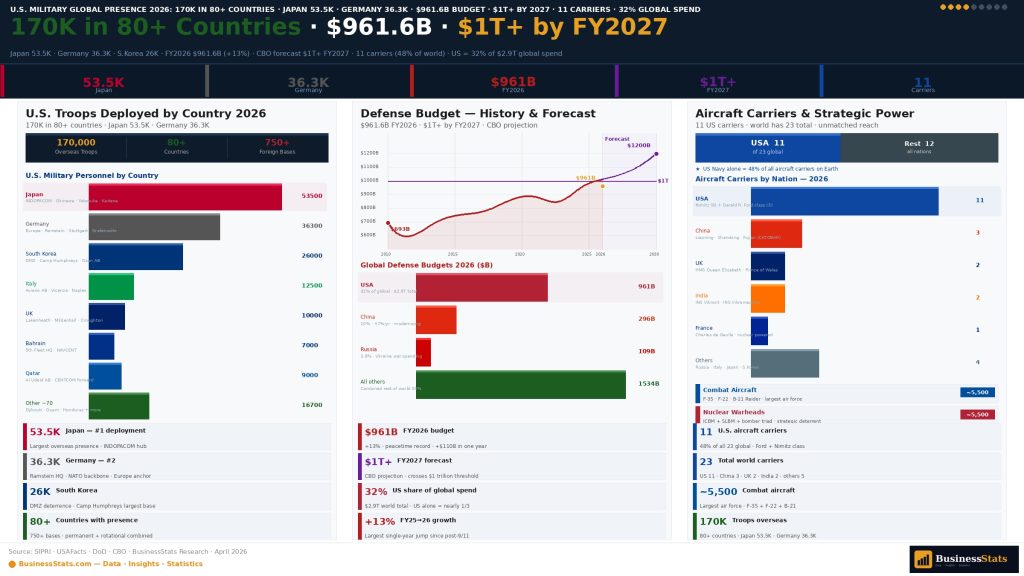
Approximately 170,000 US active duty troops were stationed abroad as of September 2025, representing 13 percent of all active duty personnel with unclassified locations. Japan leads at 53,500, hosting the 7th Fleet headquarters at Yokosuka and multiple Air Force and Marine Corps installations. Germany at 36,300 reflects reinforced NATO commitments following Russia's 2022 invasion of Ukraine. South Korea at 28,500 operates under the Combined Forces Command framework, providing a deterrent against North Korean aggression alongside approximately 600,000 South Korean active duty troops. US Special Operations Command maintains a simultaneous presence in approximately 80 countries. In 2026, the overseas deployment picture intensified dramatically with Operation Epic Fury requiring two carrier strike groups in the Middle East and a simultaneous Caribbean naval buildup for counter-narcotics operations. The global investment banking context for sovereign defense programs is in our global investment banking analysis.
11 Aircraft Carriers, 5,500 Aircraft, 67 Nuclear Submarines — U.S. Military Capability Overview
The United States operates a military capability portfolio unmatched in breadth and technological sophistication. The nuclear arsenal consists of approximately 5,550 total warheads, with approximately 1,700 deployed across the strategic triad: Minuteman III ICBMs in five US states, Trident II D5 SLBMs on 14 Ohio-class nuclear submarines, and nuclear-capable B-52H Stratofortress, B-2A Spirit, and the new B-21 Raider strategic bombers. The modernization of all three triad legs is costing approximately $1.7 trillion over 30 years, the largest military program in US history. The Air Force operates approximately 5,500 aircraft including approximately 2,000 combat aircraft, more than any other nation. The Army operates approximately 3,700 M1A2 Abrams main battle tanks and the world's largest military helicopter fleet at approximately 4,000 rotary-wing aircraft. The scale of US defense industry and its relationship to broader US wealth creation is analyzed in our BlackRock and global investment analysis.
- Nuclear triad: ~5,550 total warheads · ~1,700 deployed · Minuteman III ICBMs · Trident II D5 SLBMs (14 Ohio-class SSBNs) · B-52H, B-2A, B-21 Raider bombers · $1.7T modernization over 30 years
- Aircraft carriers: 11 nuclear-powered — more than all other nations combined (China: 3, UK: 2, France: 1) · Each leads a Carrier Strike Group with cruisers, destroyers, subs, ~75 aircraft per air wing
- Submarine fleet: ~67 nuclear attack submarines (SSNs) + 14 ballistic missile submarines (SSBNs) · World's largest and most advanced undersea force
- Air power: ~5,500 aircraft total · ~2,000 combat aircraft · F-22 Raptor, F-35 Lightning II, F-15E/EX, B-2A Spirit, B-21 Raider (new), B-52H Stratofortress, E-8 JSTARS
- Army: ~3,700 M1A2 Abrams tanks · ~28,000 Bradley IFVs and APCs · ~4,000 helicopters (Apache, Black Hawk, Chinook) · Largest rotary-wing fleet in the world
- Global bases: ~800 military installations outside the US · Major hubs in Japan, Germany, South Korea, Qatar, Bahrain, UK, Italy, Djibouti, Kuwait, Diego Garcia, Guam
U.S. Armed Forces — Key Statistics and Facts 2025-2026
US Defense Budget Forecast — $1 Trillion by FY2027, Space Force Targeting 20,000
The US defense budget is forecast to cross the historic $1 trillion threshold by FY2027, according to BusinessStats Research projections based on CBO Future Years Defense Program data. CBO projects defense costs would increase by 11 percent between 2029 and 2039. Key drivers include Space Force expansion (targeting 20,000 from current ~10,000), nuclear triad modernization at approximately $56 billion annually, Navy shipbuilding toward the congressional 355-ship goal, and sustained post-Iran conflict Middle East operational costs. China's military budget is growing at approximately 7-8 percent annually and is projected to reach $350-400 billion by 2030, still well below US spending, but the gap is narrowing. The US structural budget pressure from $600 billion in military compensation (up 162% since 1980 in real terms) creates persistent upward cost momentum that makes budget reductions politically and strategically difficult. The wealth distribution context driving the US economic capacity for this level of defense spending is in our US wealth analysis.
Frequently Asked Questions — U.S. Armed Forces Statistics 2026
As of 2025-2026, approximately 1.3 million active duty service members serve across six branches. Total force including reserves: 2.1 million uniformed personnel. An additional 701,000 civilian DoD employees bring the total combined workforce to approximately 2.86 million. Active duty grew 1.5% between March 2024 and March 2025, reversing years of decline. Source: DMDC October 2025, USAFacts September 2025.
The FY2026 defense budget request is $961.6 billion, a 13 percent increase over FY2025 enacted levels, one of the largest single-year jumps in US history. Air Force $301.1B (largest) · Navy $292.2B · Army $197.4B · Defense-wide $170.9B. Source: DoD FY2026 budget request.
The US Army is the largest branch with 455,824 active duty soldiers as of October 31, 2025, followed by the Navy at 341,496 and the Air Force at 318,983. The Army accounts for 34% of active duty and 65% of all reservists. It also has the largest reserve: ~330,000 Army National Guard + ~180,000 Army Reserve. Source: DMDC October 2025.
Approximately 170,000 US active duty troops were stationed abroad as of September 2025, representing 13% of all active duty personnel. Japan leads at 53,500, followed by Germany 36,300 and South Korea approximately 28,500. Special Operations Command operates in approximately 80 countries simultaneously. Source: USAFacts September 2025.
The US accounts for approximately 32 percent of global military expenditure totaling nearly $2.9 trillion worldwide in 2024. US spending (~$916B including nuclear programs and veterans benefits) exceeds the combined budgets of the next 9 countries: China ($225B), Russia ($109B), India ($83B), Saudi Arabia ($75B), UK ($74B), Germany ($67B), France ($61B), South Korea ($50B), Japan ($46B). Source: SIPRI 2024.
Army (455,824) · Navy (341,496) · Air Force (318,983) · Marine Corps (~177,000) · Coast Guard (~40,800) · Space Force (~10,000). Space Force was established December 2019, the first new branch since the Air Force in 1947. The Coast Guard falls under the Department of Homeland Security in peacetime. Source: DMDC October 2025.
The National Guard has 433,990 members as of September 2025, with 97% residing in the US. Reserve components: Army Reserve ~180,000 · Air Force Reserve ~70,000 · Navy Reserve ~57,000 · Marine Corps Reserve ~33,000. Army National Guard alone: ~330,000 with dual state-federal mission. Source: USAFacts September 2025.
With the FY2026 request at $961.6 billion, BusinessStats Research forecasts the US defense budget will cross $1 trillion by FY2027 for the first time in history. Key drivers: Space Force expansion, nuclear triad modernization ($56B/yr), Navy shipbuilding, and post-Iran conflict operational costs. Based on CBO Future Years Defense Program projections. Not official DoD guidance.
The United States operates 11 nuclear-powered aircraft carriers, more than all other nations combined (China 3, UK 2, France 1). Each carrier leads a Carrier Strike Group. The newest class, Gerald R. Ford, entered service 2017 with electromagnetic catapults and advanced sensors. Nimitz-class carriers (10) are progressively being upgraded. Each air wing carries approximately 75 aircraft. Source: US Navy 2025.
The US maintains approximately 5,550 nuclear warheads in total stockpile, of which approximately 1,700 are deployed on the strategic nuclear triad: Minuteman III ICBMs, Trident II D5 SLBMs on 14 Ohio-class submarines, and nuclear-capable B-52H, B-2A, and B-21 Raider bombers. Total modernization program: approximately $1.7 trillion over 30 years. Source: Federation of American Scientists Nuclear Notebook 2025.
Operation Epic Fury, the joint US-Israel campaign against Iran beginning February 28, 2026, cost over $11.3 billion in the first six days alone per Pentagon testimony to Congress. The operation involved nearly 900 strikes in the first 12 hours, deployed two carrier strike groups simultaneously, and resulted in 15 US soldiers killed. A conditional ceasefire was declared April 8, 2026, with talks ongoing in Pakistan. Source: Pentagon Congressional testimony April 2026.
Yes. All active duty branches achieved or surpassed their FY2025 recruiting goals. The Army hit its target of 61,000 new soldiers months ahead of schedule. Total active duty grew 1.5% between March 2024 and March 2025, reversing years of declining numbers. Structural challenges remain: only ~23% of 17-24 year olds are eligible without a waiver. Source: DMDC, The World Data February 2026.