Netflix Marketing Spend 2017-2026 — $3.30B in 2025, Up 13.2%
NetflixMarketing Spend2017-2026

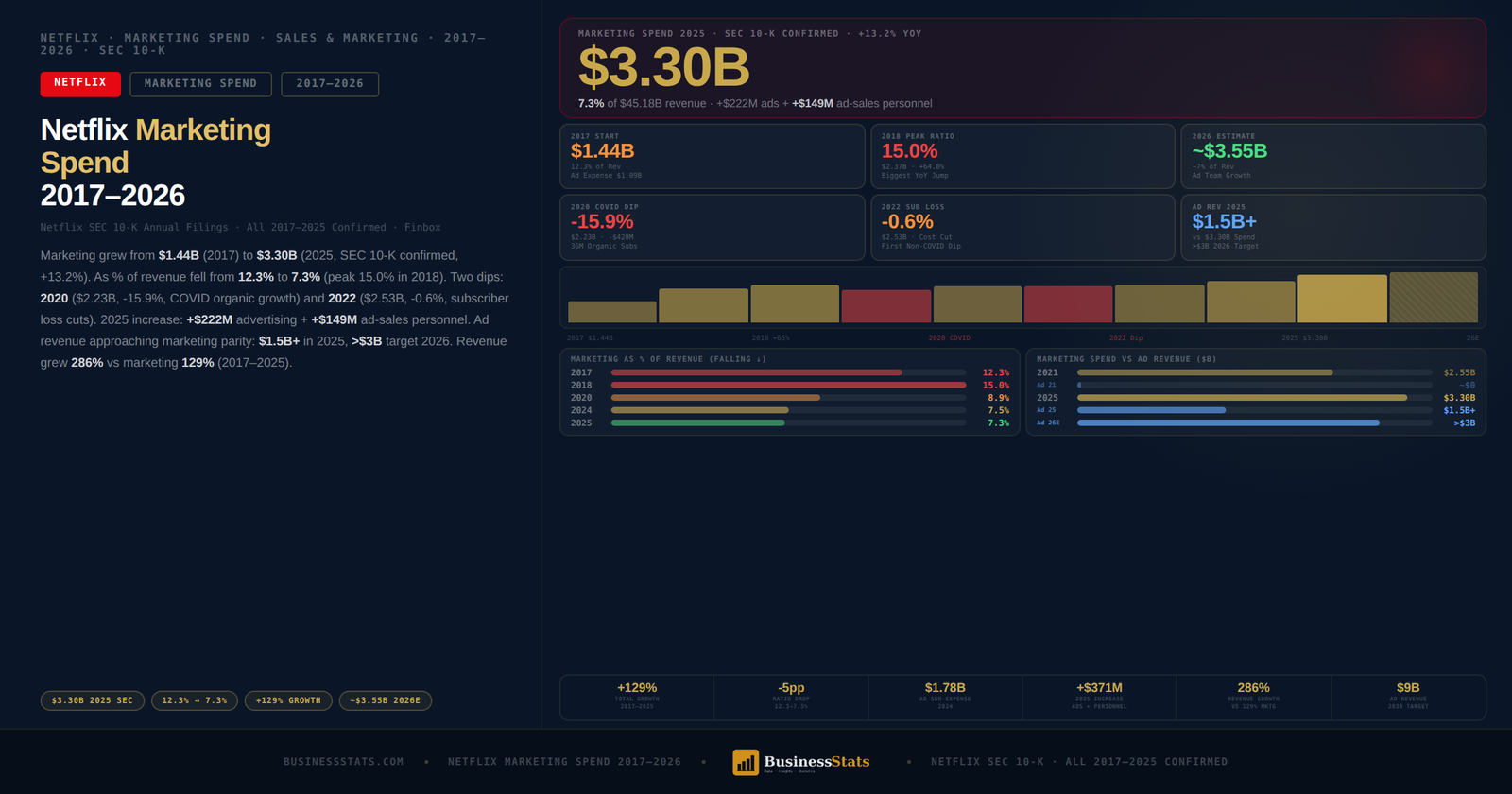
Netflix marketing spend worldwide from 2017 to 2026

Netflix's annual marketing expenses grew from $1.44 billion in 2017 to $3.30 billion in 2025, a 129% increase in eight years, confirmed from Netflix SEC 10-K annual filings. But the more revealing figure is what marketing costs as a proportion of revenue: it has fallen from 12.3% in 2017 to 7.3% in 2025, demonstrating improving marketing efficiency as Netflix's brand strength and the organic pull of its ad-supported tier reduce the cost of subscriber acquisition. Two notable dips interrupted the trend: 2020, when COVID-19 lockdowns made marketing almost unnecessary as subscribers flocked to the platform without advertising, and 2022, when Netflix's first subscriber loss crisis prompted cost-cutting across all operating lines. By 2025, Netflix has an additional reason to invest in marketing: advertising sales headcount, which now represents a significant component of the "sales and marketing" line as Netflix builds out its $1.5 billion-and-growing ad business.

BS
BusinessStats Research Desk
Streaming Industry and Media Finance Intelligence Division
Methodology and Data Sources
All data confirmed from Netflix SEC 10-K annual filings: 2017: $1,436,281 thousand (from 10-K FY2019 restated). 2018: $2,369,469 thousand (10-K FY2019). 2019: $2,652,462 thousand (10-K FY2020). 2020: $2,228,362 thousand (10-K FY2020). 2021: $2,545,146 thousand (10-K FY2023). 2022: $2,530,502 thousand (10-K FY2023). 2023: $2,657,883 thousand (10-K FY2024). 2024: $2,917,554 thousand (10-K FY2024). 2025: $3,301,306 thousand (10-K FY2025, filed January 2026). Source: Netflix EDGAR filings — primary.
Line item labeling: Netflix's income statement line was labeled "Marketing" through FY2023 and renamed "Sales and marketing" from FY2024 onwards to reflect the growing advertising sales team. The economic content is the same — all marketing-related expenses including advertising, partner payments, and personnel. Advertising expenses (a sub-component of total marketing) are also disclosed: 2022: $1,586M, 2023: $1,732M, 2024: $1,779M. The 2025 10-K noted the increase was "primarily driven by a $222M increase in marketing expenses, coupled with a $149M increase in personnel-related costs."
2026 estimate: ~$3.55 billion. Based on: (1) Netflix's marketing-to-revenue ratio has stabilized at approximately 7% for 2024-2025; (2) Netflix's 2026 revenue guidance of $50.7-51.7 billion; (3) Continued growth in advertising sales headcount as Netflix scales its ad business to $3B+ in 2026. Applying 7% of $50.7B midpoint = ~$3.55B. Not investment advice.
$3.30BMarketing Spend 2025 — SEC 10-K Confirmed
+13.2%YoY Growth 2025 — Highest Since 2018
$1.44BMarketing Spend 2017 — Starting Point
7.3%Marketing as % of Revenue 2025
12.3%Marketing as % of Revenue 2017 — Peak Ratio
~$3.55BMarketing Spend 2026 Estimate
$3.30B2025 (SEC)
+13.2%2025 Growth
$1.44B2017 Start
7.3%% Revenue 2025
~$3.55B2026E

Netflix's marketing expenses worldwide — $1.44B in 2017 to $3.30B in 2025

Netflix's marketing spending has more than doubled from $1.44 billion in 2017 to $3.30 billion in 2025, all confirmed from Netflix SEC 10-K annual filings. The 2025 figure of $3,301,306 thousand represents a 13.2% year-on-year increase, the fastest marketing growth rate since 2018.

The Netflix 10-K explains the increase: primarily a $222 million increase in marketing expenses (advertising and promotional activities) plus a $149 million increase in personnel costs due to the growth of Netflix's advertising sales headcount as it scales its $1.5 billion ad business.

The full Netflix profitability context driven by this marketing investment is in our Netflix net income analysis.

The marketing spend trajectory reveals two distinct eras. From 2017 to 2019, Netflix invested heavily in international expansion marketing, spending $2.65 billion in 2019 as it pursued rapid subscriber growth across 190 countries.

From 2020 to 2023, spending was more restrained, ranging from $2.23 billion to $2.66 billion, as COVID-driven organic growth, then password-crackdown recovery, reduced the need for paid subscriber acquisition.

From 2024 onwards, marketing has accelerated again, driven by a new reason: building Netflix's advertising business requires dedicated sales teams, technology partnerships, and advertiser outreach that all flow through the sales and marketing line. The subscriber context for this marketing investment is in our Netflix U.S. and Canada subscriber analysis.

Netflix Marketing Spend Worldwide 2017-2026 (bnUSD)
Netflix's Marketing Expenses Worldwide — 2017 to 2026 (billion USD, SEC 10-K confirmed)
$3.30B
2025 — SEC 10-K confirmed · +13.2% YoY
Source: Netflix SEC 10-K annual filings FY2017-FY2025 · All confirmed figures · 2026E = BusinessStats Research estimate
  • 2017: $1.44B (12.3% of revenue) — International expansion era begins. Heavy digital and TV advertising to drive subscriber growth. Revenue $11.69B.
  • 2018: $2.37B (+64.8%) — Largest single-year marketing increase. Netflix launches aggressively in new markets with advertising campaigns for Stranger Things, Roma, Bird Box. Revenue $15.79B.
  • 2019: $2.65B (+11.9%) — Pre-COVID peak. Subscriber growth strong. $1.879B in advertising expenses alone. Revenue $20.16B.
  • 2020: $2.23B (-15.9%) — COVID lockdowns. Marketing cut sharply as 36 million subscribers signed up organically. Lowest marketing spend since 2018.
  • 2022: $2.53B (-0.6%) — First decline outside COVID. Subscriber loss crisis drives cost-cutting. Netflix reduced marketing as it pivoted to password crackdown strategy.
  • 2025: $3.30B (+13.2%) — New all-time record. Advertising sales headcount growing rapidly. $222M more in promotional marketing, $149M more in ad-sales personnel. 7.3% of revenue.

Netflix Marketing Spend — Full Annual Data 2017-2026 (billion USD, all SEC confirmed)

The table below shows Netflix's annual marketing (sales and marketing) expenses from 2017 to 2026. All 2017-2025 figures are confirmed from Netflix SEC 10-K annual filings. The global revenue context is in our Netflix revenue statistics analysis.

Netflix Marketing Expenses Worldwide — 2017 to 2026 (billion USD, GAAP) Click column to sort ↕
YearMarketing Spend ($B)YoY ChangeTotal Revenue ($B)% of RevenueAdvertising Sub-Expense ($B)Key Event
2017$1.44B$11.69B12.3%$1.09BInternational expansion · Stranger Things S1 · 117M subscribers
2018$2.37B+64.8%$15.79B15.0%$1.81BBiggest YoY jump · Bird Box · Roma · 139M subscribers
2019$2.65B+11.9%$20.16B13.2%$1.88BPre-COVID peak · Stranger Things S3 · 167M subscribers
2020$2.23B-15.9%$24.99B8.9%$1.45BCOVID — organic growth · Marketing cut · +36M subscribers without ads
2021$2.55B+14.2%$29.70B8.6%$1.67BPost-COVID rebound · Squid Game 265M views · 221M subscribers
2022$2.53B-0.6%$31.62B8.0%$1.59BSub-loss year · Cost-cutting · First decline outside COVID
2023$2.66B+5.0%$33.72B7.9%$1.73BPassword crackdown · Ad tier growing · +29M subscribers
2024$2.92B+9.8%$39.00B7.5%$1.78BAd sales team builds · 302M subscribers · +41M annual adds
2025$3.30B+13.2%$45.18B7.3%~$2.0BAll-time record · +$222M ads, +$149M ad-sales personnel · 325M+ subs
2026E~$3.55B~+7.6%~$51.2B~7.0%~$2.1BBusinessStats estimate · 7% of guided $50.7-51.7B revenue

What Netflix's $3.30B Marketing Budget Includes — Advertising, Partners, and Ad-Sales Teams

Netflix's "sales and marketing" line in its income statement covers three categories. The largest is advertising and promotional activities, digital advertising (Google, Meta, programmatic), television advertising in key launch markets, out-of-home campaigns for major original releases (billboards, transit advertising), and cinematic promotional events.

In 2024, the advertising sub-component was $1,779 million, approximately 61% of the total $2.918 billion marketing budget. In 2025, marketing expenses grew $222 million, largely reflecting increased promotional spending on major original launches and brand campaigns. The streaming content context for what is being marketed is in our Netflix content spending analysis.

The second category is partner payments, fees paid to consumer electronics manufacturers, cable and satellite distributors, mobile operators, and ISPs in exchange for prominent placement of the Netflix app on devices and in-store marketing support.

These partner deals, with Samsung, LG, Apple (App Store placement), T-Mobile, and others, represent a significant portion of Netflix's marketing budget that is not traditional advertising.

The third category, which is driving the rapid marketing spend growth in 2024-2025, is advertising sales personnel, the engineers, salespeople, account managers, and technology staff required to build and operate Netflix's advertising business. As Netflix scales to 94 million ad-tier users and targets $3 billion in ad revenue by 2026, this headcount is growing rapidly.

The ad-tier subscriber context is in our Netflix statistics and facts.


Marketing as % of Revenue — Declining from 12.3% to 7.3% — Growing Efficiency

Netflix Marketing Spend as % of Total Revenue — 2017 to 2026
Netflix Marketing Expenses as Percentage of Revenue — 2017 to 2026 (%)
7.3%2025 (vs 12.3% in 2017)
-5ppEfficiency gain 2017-2025
Source: Netflix SEC 10-K FY2017-FY2025 (all confirmed) · Marketing/Revenue × 100 · 2026E: BusinessStats Research estimate

The declining marketing-to-revenue ratio is one of the clearest indicators of Netflix's growing competitive strength. In 2018, Netflix's most aggressive international expansion year, marketing consumed 15.0% of revenue: 15 cents of every dollar earned went to marketing. By 2025, that figure was just 7.3%. The improvement reflects several structural changes.

Netflix's brand is now among the most recognised globally, reducing the cost of awareness marketing. Its recommendation algorithm has become one of the world's most sophisticated content discovery tools, reducing churn. The password-sharing crackdown proved that Netflix could convert non-paying users into subscribers without heavy paid advertising.

And the ad-supported tier attracts price-sensitive subscribers at a lower acquisition cost than the full-price tiers. The revenue trend context is in our Netflix revenue by region analysis.


The Two Marketing Dips — 2020 (COVID) and 2022 (Subscriber Loss)

Netflix's marketing spending has dipped twice in the 2017-2026 period. The 2020 COVID dip was dramatic and intentional: marketing fell from $2.65 billion in 2019 to $2.23 billion in 2020, a reduction of $420 million (-15.9%). With lockdowns driving 36 million new subscribers organically, Netflix rationally reduced marketing investment, subscribers were coming without it.

Production shutdowns also eliminated the need for film premiere marketing, theatrical release campaigns, and live event advertising. The 2020 dip was purely opportunistic cost management, not a strategic retreat. The 2022 dip was smaller but more significant in context.

Marketing fell only $14 million (-0.6%) from 2021's $2.55 billion to 2022's $2.53 billion, but this was the first time marketing declined outside of COVID, and it coincided with Netflix's worst subscriber year. Management cut marketing as part of a broader cost-reduction program when subscriber losses became apparent in Q1 2022.

The broader financial context for the 2022 crisis is in our Netflix net income analysis.


Netflix Marketing Spend vs Advertising Revenue — Approaching Parity by 2026

Netflix Marketing Spend vs Advertising Revenue — 2021-2026 (bnUSD)
Netflix Total Marketing Spend vs Advertising Revenue Generated — 2021 to 2026 (billion USD)
$1.5B+Ad Revenue 2025
>$3BAd Revenue 2026 Target
Source: Netflix SEC 10-K FY2021-FY2025 (marketing) · Netflix Q4 2025 8-K (ad revenue $1.5B+ confirmed) · 2026 ad revenue = Netflix official guidance · Market value context: BusinessStats internet companies analysis

The chart above illustrates one of Netflix's most compelling financial narratives. In 2021, Netflix spent $2.55 billion on marketing and generated essentially zero advertising revenue, the ad-supported tier had not yet launched. By 2025, Netflix spent $3.30 billion on marketing and generated over $1.5 billion in advertising revenue.

By 2026, Netflix targets over $3 billion in advertising revenue, which would approach parity with its total marketing spend of approximately $3.55 billion. This is transformative: Netflix's marketing investment is not only acquiring subscribers, it is also building the commercial infrastructure (the ad tech stack, the advertiser relationships, the sales team) that generates a rapidly growing revenue stream.

The $9 billion long-term ad revenue target by 2030 suggests this revenue could eventually exceed Netflix's total marketing spend by a wide margin. The market cap context for this transformation is in our largest internet companies by market cap analysis.


Netflix Marketing Spend — Key Statistics and Facts 2017-2026

$3.30B
Marketing Spend 2025 — All-Time Record (SEC Confirmed)
$3,301,306 thousand — confirmed from Netflix SEC 10-K FY2025. Represents 7.3% of $45.18B revenue. Year-on-year growth: +13.2% — the fastest since 2018. Increase driven by: +$222M marketing expenses, +$149M ad-sales personnel costs. Source: Netflix 10-K FY2025, filed January 2026.
+64.8%
Biggest YoY Jump — 2018 (+$930M in One Year)
Marketing grew from $1.44B (2017) to $2.37B (2018) — a $930M increase in a single year, the largest absolute and percentage gain in the dataset. This reflected Netflix's most aggressive international expansion year, with major campaigns for Bird Box, Roma, and Stranger Things S2. Advertising sub-expense grew from $1.09B to $1.81B (+66%). Source: Netflix SEC 10-K FY2018, FY2019.
12.3%
Peak Marketing Ratio — 2017 (12.3% of Revenue)
In 2017, Netflix spent 12.3 cents of every revenue dollar on marketing. The ratio peaked at 15.0% in 2018 during the international expansion push. By 2025, this had fallen to 7.3% — a 4.9-percentage-point improvement indicating structural marketing efficiency gains. At 2025 revenue ($45.18B), 1pp ratio improvement = ~$450M more efficient. Source: Netflix SEC 10-K FY2017, FY2025.
$2.23B
2020 — Biggest Drop (-$420M, COVID Year)
Marketing fell from $2.65B (2019) to $2.23B (2020) — a $420M reduction (-15.9%) — because COVID-19 lockdowns drove 36 million subscribers organically without marketing. Netflix cut marketing spend intentionally, demonstrating that the brand is strong enough to grow without heavy advertising in unusual circumstances. Source: Netflix SEC 10-K FY2020.
$1.78B
Advertising Sub-Expense 2024 (Within Total Marketing)
Netflix's advertising expenses (promotional activities including digital and TV ads) were $1,779 million in 2024 — confirmed from 10-K FY2024. The remaining ~$1.14B of the $2.918B total marketing was partner payments and personnel. 2023: $1,732M. 2022: $1,586M. These figures are disclosed in the 10-K notes. Source: Netflix SEC 10-K FY2024.
7.3%
Marketing as % Revenue 2025 — Down from 12.3% in 2017
Netflix's marketing-to-revenue ratio has declined from 12.3% (2017) to 7.3% (2025) despite absolute spend nearly doubling. The 5.0-percentage-point improvement reflects: brand strength reducing acquisition costs, password-crackdown efficiency, algorithm-driven retention, and organic ad-tier growth. Netflix maintains 7% ratio in both 2024 and 2025. Source: Netflix SEC 10-K FY2017, FY2025.
~$3.55B
Marketing Spend 2026 Estimate
BusinessStats Research estimate: ~$3.55 billion in 2026 (approximately 7% of $50.7-51.7B guided revenue). Netflix's ad-sales team will continue growing as it builds toward $3B+ in ad revenue. Marketing spend growth of ~+7-8% in 2026 is expected to moderate from 2025's 13.2% pace. Not investment advice. Source: Netflix Q4 2025 8-K guidance, BusinessStats estimate.
+129%
Total Marketing Growth 2017-2025 ($1.44B to $3.30B)
Netflix's marketing spend grew 129% from $1.44B in 2017 to $3.30B in 2025 — an increase of $1.86 billion over eight years. Over the same period, revenue grew 286% ($11.69B to $45.18B) — meaning revenue grew more than twice as fast as marketing, explaining the improving marketing-to-revenue ratio. Source: Netflix SEC 10-K FY2017, FY2025.

Netflix Marketing Spend 2026 — ~$3.55B Estimated, Advertising Sales Team Continues Growing

Netflix's 2026 marketing budget is expected to grow to approximately $3.55 billion, representing approximately 7% of Netflix's guided $50.7-51.7 billion in revenue. The primary growth driver will continue to be the expansion of Netflix's advertising sales infrastructure.

With the company targeting over $3 billion in advertising revenue in 2026, double the 2025 level, the advertising sales team will need to continue growing rapidly. Additional ad tech engineers, account managers, programmatic advertising specialists, and marketing operations staff will all flow through the sales and marketing line.

Promotional marketing spend on major original releases (Stranger Things Season 5, Wednesday Season 3, and major live sports events including expanded NFL deals) will also contribute to 2026 marketing growth. The broader Netflix profitability context for this spend is in our Netflix cost of revenues analysis.

Netflix Marketing Spend — 2026 Outlook
Netflix Marketing Expenses — 2025 Confirmed vs 2026 BusinessStats Estimate
$3.30BMarketing Spend 2025 — SEC 10-K Confirmed (+13.2%)
~$3.55BMarketing Spend 2026E — BusinessStats Estimate (~+7-8%)
7.3%Marketing as % Revenue 2025
~7.0%Projected Marketing % Revenue 2026E
$1.5B+Advertising Revenue 2025 (Marketing is Generating ROI)
>$3BNetflix Ad Revenue 2026 Target — Approaching Marketing Parity

Frequently Asked Questions — Netflix Marketing Spend 2017-2026

Netflix marketing (sales and marketing) spend 2025: $3.301 billion, confirmed from Netflix SEC 10-K FY2025. Up 13.2% from $2.918B in 2024. Represents 7.3% of $45.18B revenue. Increase driven by: +$222M advertising expenses, +$149M advertising sales headcount growth. Source: Netflix 10-K FY2025.

Netflix's sales and marketing includes: (1) Advertising expenses, digital and TV promotional advertising (~55-65% of total, e.g. $1.779B of $2.918B in 2024). (2) Partner payments, CE manufacturers, MVPDs, ISPs. (3) Ad sales personnel, growing rapidly as Netflix scales its ad business. Source: Netflix SEC 10-K FY2025 description.

Marketing fell from $2.65B (2019) to $2.23B (2020), a -$420M drop (-15.9%), because COVID-19 lockdowns drove 36 million subscribers organically. Netflix cut marketing intentionally, as paid advertising was unnecessary when subscribers were joining organically. Production shutdowns also eliminated promotional campaigns for new releases. Source: Netflix SEC 10-K FY2020.

Netflix marketing-to-revenue ratio: 2017: 12.3%, 2018: 15.0% (peak), 2019: 13.2%, 2020: 8.9%, 2021: 8.6%, 2022: 8.0%, 2023: 7.9%, 2024: 7.5%, 2025: 7.3%. The 4.9pp decline from 2017 to 2025 reflects growing marketing efficiency, Netflix's brand and algorithm reducing acquisition costs. Source: Netflix SEC 10-K FY2017-FY2025.

Netflix marketing spend in 2017: $1,436,281 thousand ($1.44 billion), confirmed from Netflix SEC 10-K FY2019 (restated). This represented 12.3% of $11.69B revenue. Advertising sub-expense in 2017: $1.091 billion. By 2025, spend had grown to $3.30B, a 129% increase. Source: Netflix SEC 10-K FY2019 (2017 restated data).

In 2025: Netflix spent $3.30B on marketing while generating $1.5B+ in advertising revenue. By 2026, Netflix targets $3B+ in ad revenue, approaching parity with its ~$3.55B marketing budget. The marketing investment is building the ad-sales infrastructure that generates this growing revenue. 2030 target: $9B ad revenue. Source: Netflix 10-K FY2025, Q4 2025 8-K guidance.

Marketing jumped +64.8% from $1.44B to $2.37B in 2018, the largest single-year increase in the dataset. This reflected Netflix's most aggressive international expansion, with major campaigns for Bird Box (80M views in first week), Roma (Oscar Best Picture), Stranger Things, and the launch of Netflix in new markets. Advertising expenses grew from $1.09B to $1.81B (+66%). Source: Netflix SEC 10-K FY2018, FY2019.

BusinessStats Research estimates approximately $3.55 billion for 2026, representing approximately 7% of Netflix's guided $50.7-51.7B revenue. Growth is expected to moderate to ~7-8% (from 2025's 13.2%) as the initial advertising sales team build-out stabilises. Not investment advice. Source: Netflix Q4 2025 8-K guidance, BusinessStats estimate.