
NASDAQ — The Exchange That Powered the Technology Revolution
When the National Association of Securities Dealers Automated Quotations system — NASDAQ — launched on February 8, 1971, its founders could not have imagined what it would become. It started as little more than an electronic price-quotation system for over-the-counter stocks, replacing the telephone-based system that dealers had used since the 1800s. Fifty-five years later, NASDAQ is the world's second-largest stock exchange by market capitalization at approximately $24 trillion, home to the most valuable companies in human history, and the undisputed global center of technology stock trading. Understanding NASDAQ requires understanding the fundamental stock market terminology that underpins how exchanges work — from market cap and P/E ratios to trading volume and index construction.
The numbers are extraordinary. The top five NASDAQ-listed companies by market cap — Apple, Nvidia, Microsoft, Amazon, and Alphabet — together represent approximately $14 trillion in equity value, exceeding the entire GDP of China. The NASDAQ Composite index has risen from 100 points at inception in 1971 to approximately 19,500 points in 2025 — a gain of 19,400% in 54 years. The NASDAQ-100 index, which tracks the 100 largest non-financial NASDAQ companies, has delivered approximately +18% annually over the past decade — one of the strongest 10-year runs of any major index in history, driven overwhelmingly by the AI and technology supercycle. NASDAQ's dominance also intersects with the broader story of wealth creation, explored in our analysis of the world's richest countries — where US equity wealth is a primary driver of American per-capita dominance.
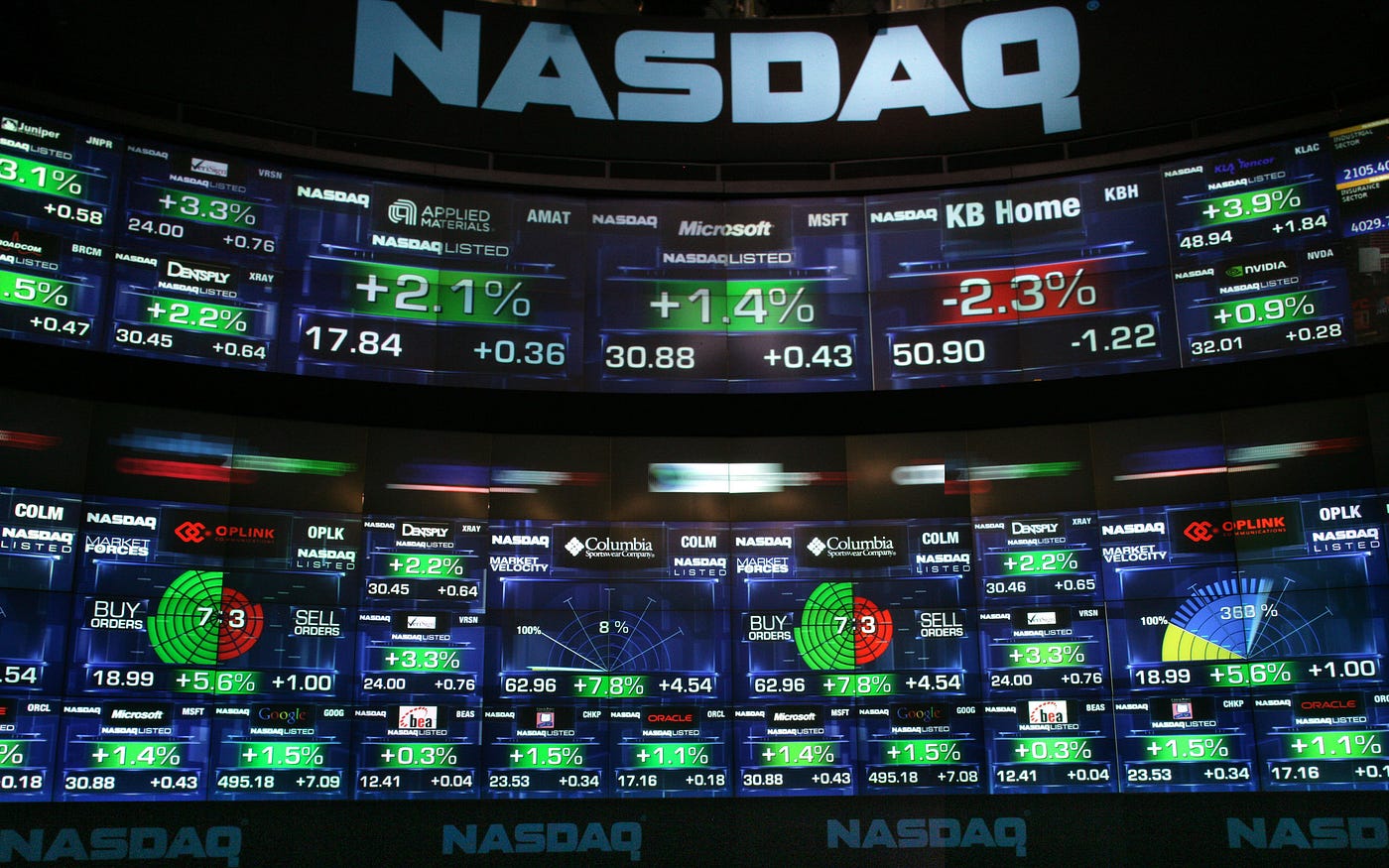
NASDAQ History — From Electronic Bulletin Board to $24 Trillion Exchange
NASDAQ by the Numbers — Complete Statistics 2025
NASDAQ Composite Index 1990–2025: Boom, Bust, and Record Recovery
No chart in financial history tells a more dramatic story than the NASDAQ Composite from 1990 to 2025. The index encapsulates the dot-com mania of the late 1990s (600 → 5,048 in 10 years), the catastrophic crash (-78% in 2.5 years), the long recovery (15 years to return to 2000 highs), and the extraordinary AI-driven surge that has taken the index to levels unimaginable in 2000. The NASDAQ Composite is now a direct barometer of the global technology sector — when Nvidia reports earnings, when Apple launches a product, when the Federal Reserve changes interest rate policy, the NASDAQ reacts instantly and powerfully.
Largest NASDAQ-Listed Companies by Market Cap 2025
The concentration of market value in NASDAQ's top companies is extraordinary. The top 10 companies by market cap account for approximately 55% of total NASDAQ market capitalization — meaning a handful of technology giants effectively determine the daily movement of the entire exchange. This concentration is both NASDAQ's greatest strength (it houses the most productive, profitable technology companies in history) and its greatest risk (a sell-off in just 5 companies can move the entire index significantly). For context on how these companies compare to national economies, our analysis of the world's richest countries shows that Apple's market cap alone exceeds the GDP of Italy or Brazil.
| # | Company | Market Cap | 2025 Revenue | P/E Ratio | 5yr Return | Sector |
|---|---|---|---|---|---|---|
| 1 | Apple (AAPL) | $3.5T | $400B | 28x | +165% | Technology |
| 2 | Nvidia (NVDA) | $3.2T | $130B | 35x | +1,800% | Semiconductors |
| 3 | Microsoft (MSFT) | $3.0T | $245B | 32x | +180% | Technology |
| 4 | Alphabet (GOOG) | $2.3T | $350B | 22x | +145% | Technology |
| 5 | Amazon (AMZN) | $2.2T | $620B | 38x | +120% | E-commerce/Cloud |
| 6 | Meta (META) | $1.6T | $165B | 25x | +320% | Social Media |
| 7 | Tesla (TSLA) | $900B | $98B | 65x | +85% | EV / Energy |
| 8 | Broadcom (AVGO) | $800B | $51B | 26x | +290% | Semiconductors |
| 9 | Netflix (NFLX) | $400B | $39B | 42x | +220% | Streaming |
| 10 | AMD (AMD) | $250B | $25B | 30x | +180% | Semiconductors |
| 11 | Intel (INTC) | $95B | $54B | 15x | -55% | Semiconductors |
| 12 | Qualcomm (QCOM) | $190B | $39B | 17x | +95% | Semiconductors |
| 13 | Costco (COST) | $380B | $242B | 48x | +155% | Retail |
| 14 | Pepsico (PEP) | $210B | $92B | 22x | +15% | Consumer |
| 15 | Starbucks (SBUX) | $95B | $36B | 24x | -10% | Consumer |
NASDAQ-100 — The World's Most Powerful Tech Index
The NASDAQ-100 (NDX) is one of the most influential stock market indices in the world. It tracks the 100 largest non-financial companies listed on NASDAQ, weighted by market capitalization. The index is rebalanced quarterly and reconstituted annually. Because it excludes financial companies (banks, insurance firms), it is overwhelmingly concentrated in technology, consumer discretionary, and communication services. The top 10 holdings typically represent approximately 55–60% of total index weight — making it one of the most concentrated major indices globally. The most popular way to invest in the NASDAQ-100 is through the Invesco QQQ Trust (QQQ) — the world's fifth-largest ETF with approximately $300 billion in assets under management.
From 2005 to 2025, the NASDAQ-100 returned approximately +1,100% — compared to approximately +390% for the S&P 500 over the same period. A $10,000 investment in QQQ in 2005 would be worth approximately $120,000 in 2025 vs approximately $49,000 in SPY. This extraordinary outperformance reflects the technology sector's structural dominance of corporate profit growth. However, the concentration risk is real: in 2022, the NASDAQ-100 fell -33% while the S&P 500 fell only -18% — the flip side of concentration.
NASDAQ Sector Composition — Technology Dominates at 55%
NASDAQ's sector composition is dramatically different from the NYSE or the S&P 500. Technology companies dominate, comprising approximately 55% of total NASDAQ market capitalization — compared to approximately 32% in the S&P 500. This tech concentration means NASDAQ moves are amplified by semiconductor cycles, cloud computing growth, AI adoption rates, and Federal Reserve interest rate policy (which particularly affects high-valuation growth stocks). The rise of cryptocurrencies and blockchain technology has also added a new dimension — several crypto-related companies like Coinbase, MicroStrategy, and various Bitcoin ETF issuers are now NASDAQ-listed, adding further volatility and correlation with global crypto market dynamics.
NASDAQ Trading Volume — $25 Billion Per Day, World's Most Liquid Tech Market
NASDAQ processes approximately $25 billion in daily equity trading volume — making it the world's most liquid market for technology stocks. By share volume, NASDAQ regularly surpasses NYSE: approximately 1.8 billion shares trade on NASDAQ daily, compared to approximately 900 million on NYSE, reflecting the higher share counts and lower individual share prices of many NASDAQ-listed tech companies. NASDAQ's market structure — a fully electronic, competitive market-maker system with multiple designated liquidity providers — creates extremely tight bid-ask spreads for large-cap names. Apple and Microsoft typically trade at a $0.01 spread, meaning the cost of trading is essentially zero for institutional investors. The exchange's technology infrastructure processes approximately 10 million order events per second with average latency measured in microseconds.
NASDAQ vs NYSE — Head-to-Head Comparison
| Metric | NASDAQ | NYSE |
|---|---|---|
| Founded | 1971 | 1792 |
| Market Cap | ~$24 Trillion | ~$28 Trillion |
| Listed Companies | 3,300+ | 2,400+ |
| Daily Trading Volume | ~$25 Billion | ~$24 Billion |
| Trading System | Fully Electronic | Hybrid (Electronic + Auction) |
| Physical Floor | No Trading Floor | Yes — 11 Wall Street, NYC |
| Top Companies | Apple, Nvidia, Microsoft | Berkshire, JPMorgan, Visa |
| Dominant Sector | Technology (55%) | Financials, Industrials |
| Listing Fees | Lower ($50K–$150K) | Higher ($150K–$500K) |
| Min Market Cap (IPO) | $50 Million | $200 Million |
| Annual Listing Fee | $27K–$155K | $71K–$500K |
| 10yr Index Return | +280% (Composite) | +145% (DJIA) |
| Parent Company | Nasdaq Inc ($7B rev) | Intercontinental Exchange |
The Dot-Com Crash — NASDAQ's Darkest Chapter and Longest Recovery
The dot-com bubble and crash remains the defining trauma of NASDAQ's history — and arguably the most instructive episode in the history of financial markets. From January 1, 1995 to March 10, 2000, the NASDAQ Composite rose from approximately 750 to 5,048.62 — a 573% gain in just 5 years. The mania was fueled by genuine technological innovation (the commercialization of the internet), easy monetary policy, and speculative excess: companies with no revenue, no profits, and no clear path to profitability were valued at billions of dollars based on "eyeballs" and "potential." Pets.com went public in February 2000 and filed for bankruptcy in November 2000 — nine months later. Webvan, a grocery delivery service, raised $375 million in its IPO and burned through it all within 18 months.
The collapse was equally dramatic. From March 2000 to October 2002, the NASDAQ Composite fell from 5,048 to 1,114 — a 78% decline that wiped out an estimated $5 trillion in market value. The crash was compounded by the September 11, 2001 attacks, which closed US markets for 4 days and accelerated the decline. What is important for context is that the Federal Reserve and central banks responded aggressively — cutting interest rates from 6.5% to 1.75% by 2001 — but the damage was done. The recovery took 15 years: the NASDAQ Composite only surpassed its March 2000 peak on April 23, 2015 — making it the longest recovery from a major market peak in US stock market history.

NASDAQ Beyond the USA — Three Tiers and Global Technology Infrastructure
NASDAQ operates a three-tier market structure for listing requirements: the NASDAQ Global Select Market (highest standards — Apple, Microsoft, Nvidia), the NASDAQ Global Market (mid-tier, for established companies), and the NASDAQ Capital Market (for smaller growth companies). This tiering allows NASDAQ to serve everything from the world's most valuable companies to early-stage growth businesses. Beyond its US exchange operations, NASDAQ Inc operates exchanges in 29 countries, including Nordic markets (OMX exchanges in Stockholm, Helsinki, Copenhagen, Reykjavik), Baltic markets (Tallinn, Riga, Vilnius), and provides market technology to exchanges including the London Stock Exchange and the Australian Securities Exchange.
NASDAQ's technology division — selling its exchange operating software to other global exchanges — generates approximately $2.5 billion annually in recurring revenue. The company's data and analytics division generates another $1.8 billion by selling market data, index licensing, and analytics. This diversification means NASDAQ Inc is as much a financial technology company as a stock exchange. Its role in the broader digital financial ecosystem intersects with the growth of digital assets — several major Bitcoin mining companies are NASDAQ-listed, and the first US spot Bitcoin ETFs, approved in January 2024, are also NASDAQ-listed instruments.
Best Performing NASDAQ Stocks — 5-Year Returns 2020–2025
NASDAQ 2030 — AI Supercycle, $35T Market Cap & the Next Generation of Tech Giants
The outlook for NASDAQ through 2030 is shaped by three dominant forces: the AI infrastructure supercycle, the continued dominance of the Magnificent Seven, and the emergence of the next generation of technology companies. Goldman Sachs and Morgan Stanley project NASDAQ market cap could reach $30–35 trillion by 2030, driven primarily by continued earnings growth at existing mega-cap tech companies and valuation expansion from AI-driven productivity. The key question is whether current AI enthusiasm translates into durable corporate earnings — the answer will determine whether NASDAQ's 2020s trajectory mirrors the sustainable growth of the 2010s or the speculative excess of the late 1990s. Understanding both scenarios requires studying the broader relationship between equity markets and central bank monetary policy that drives valuations.
Several emerging themes will shape NASDAQ's composition by 2030: AI infrastructure companies (data center operators, custom silicon designers, power companies serving AI data centers) are likely to grow from fringe holdings to core index weights. Biotech and genomics, accelerated by AI-driven drug discovery, may rival semiconductors as a growth driver. The intersection of cryptocurrency and traditional finance — with spot Bitcoin ETFs now trading on NASDAQ and major financial institutions building crypto custody and trading infrastructure — will bring new volatility and new listings to the exchange. Our analysis of global crypto market statistics shows how deeply digital assets have penetrated institutional investment portfolios.
NASDAQ — Common Questions Answered
NASDAQ is the world's second-largest stock exchange with approximately $24 trillion in market cap, 3,300+ listed companies, and $25 billion in average daily trading volume. The NASDAQ Composite index includes all 3,300+ stocks and stood at approximately 19,500 in 2025. The exchange processes approximately 1.8 billion shares per day.
The largest NASDAQ companies by market cap (2025): Apple ($3.5T), Nvidia ($3.2T), Microsoft ($3.0T), Alphabet ($2.3T), Amazon ($2.2T), Meta ($1.6T), Tesla ($900B). Together these 7 companies represent approximately $14 trillion — nearly 60% of NASDAQ's total market cap.
NASDAQ was founded on February 8, 1971 — making it the world's first fully electronic stock exchange. It was created by the National Association of Securities Dealers (NASD) and began with 2,500 securities. Apple listed in 1980, Microsoft in 1986, Amazon in 1997, and Google/Alphabet in 2004.
The NASDAQ-100 tracks the 100 largest non-financial NASDAQ companies. Tech = ~55% of the index. Tracked by the QQQ ETF ($300B AUM, 0.20% expense ratio). 10-year annual return: +18% vs S&P 500's +13%. 20-year total return: +1,100%. Rebalanced quarterly, reconstituted annually.
The dot-com crash (2000–2002) saw NASDAQ fall -78% from peak (5,048) to trough (1,114). Causes: speculative valuations with no earnings basis, interest rate hikes by the Fed, Y2K spending hangover, and the collapse of internet advertising revenue. $5 trillion in market value destroyed. Recovery took 15 years — peak surpassed in April 2015.
NASDAQ Composite: includes ALL 3,300+ NASDAQ-listed stocks — broad index including small-caps, biotech, retail. NASDAQ-100: only the 100 largest non-financial NASDAQ companies — essentially a "best of" tech index. The NDX-100 typically outperforms the Composite in bull markets (more concentrated in winners) and underperforms in bear markets. QQQ tracks the NASDAQ-100; no direct major ETF tracks the full Composite.
Primary: NASDAQ Inc Annual Report 2025 · Exchange statistics, listed company data, trading volume.
Index Data: NASDAQ OMX Index Data · NASDAQ Composite and NASDAQ-100 historical series · Bloomberg Terminal.
Market Data: World Federation of Exchanges (WFE) · S&P Global Market Intelligence · SEC EDGAR Filings 2025.
Company Data: Individual company 10-K filings (Apple, Microsoft, Nvidia, Amazon, Alphabet, Meta, Tesla) · Bloomberg Terminal Q1 2025.
Historical: Robert Shiller Yale CAPE Data · CRSP (Center for Research in Security Prices) · Dimensional Fund Advisors historical return series 1971–2025.