
Most Visited Countries in the World — Top 20 by International Arrivals 2025
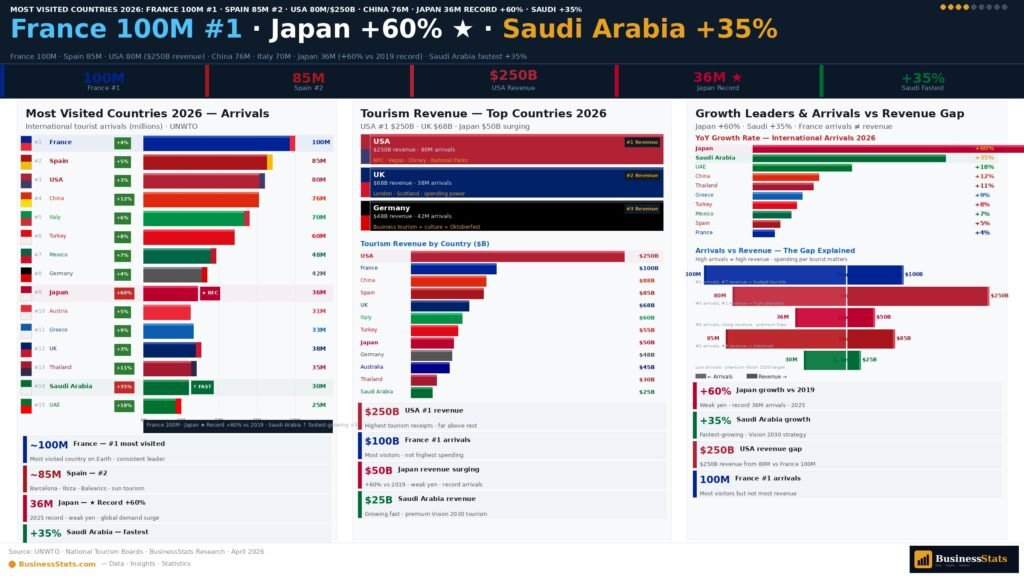
The navy bar chart below ranks the top 20 most visited countries in the world by international tourist arrivals in 2025. France's 100 million is nearly double Japan's 9th-place 36 million, illustrating how concentrated global tourism is at the top. Hover each bar to see the exact figure and year-on-year change. Europe dominates the top 10 with 6 entries, a reflection of its exceptional destination density, interconnected transport, and cultural magnetism. The broader economic context of these tourism powerhouses is analyzed in our global GDP analysis.
- 🇫🇷 France #1: ~100M · 30+ consecutive years as world's most visited · Paris alone draws 35M overnight stays
- 🇪🇸 Spain #2: ~85M · earns more per visitor than France · 13% of Spanish GDP from tourism
- 🇺🇸 USA #3: ~80M arrivals · but $250B revenue, the highest in the world by far
- 🇨🇳 China #4: ~76M · recovering fully post-COVID · domestic tourism even larger at $750B
- 🇮🇹 Italy #5: ~70M · over-tourism in Venice/Rome now a policy crisis · €5 Venice entry fee
- 🇹🇷 Turkey #6: ~60M · tripled visitors since 2010 · lira weakness making it very affordable
- 🇲🇽 Mexico #7: ~45M · 60% from USA · Cancún/Riviera Maya dominates
- 🇹🇭 Thailand #8: ~35M · Southeast Asia #1 · Bangkok world's most visited city 2019
- 🇯🇵 Japan #9: ~36M · 2025 RECORD · yen at 34-year low driving Western visitor surge
- 🇩🇪 Germany #10: ~30M · business + leisure mix · Oktoberfest, Christmas markets, BMW/Mercedes
Top 20 Most Visited Countries — Full Data Table 2025
Click any column header to sort. The table includes arrivals, revenue, GDP share, and tourism growth rate, giving the complete picture of each country's tourism performance. Sorting by Revenue reveals the USA's dominance. Sorting by GDP Share shows how dependent small economies like the Maldives and Iceland are on tourism. Sorting by Growth reveals where the new tourism momentum is building. Data from the broader global economy is covered in our financial markets analysis.
| Rank | Country | Arrivals | Revenue | Tourism % GDP | Growth vs 2024 | Top Attraction |
|---|---|---|---|---|---|---|
| 1 | 🇫🇷 France | ~100M | ~$80B | ~7% | +4% | Eiffel Tower / Paris |
| 2 | 🇪🇸 Spain | ~85M | ~$120B | ~13% | +6% | Barcelona / Costa del Sol |
| 3 | 🇺🇸 United States | ~80M | ~$250B | ~3% | +5% | New York / Orlando |
| 4 | 🇨🇳 China | ~76M | ~$45B | ~5% | +18% | Great Wall / Shanghai |
| 5 | 🇮🇹 Italy | ~70M | ~$60B | ~13% | +5% | Rome / Venice / Amalfi |
| 6 | 🇹🇷 Turkey | ~60M | ~$52B | ~10% | +8% | Istanbul / Antalya |
| 7 | 🇲🇽 Mexico | ~45M | ~$35B | ~9% | +7% | Cancún / Mexico City |
| 8 | 🇹🇭 Thailand | ~35M | ~$38B | ~18% | +12% | Bangkok / Phuket / Chiang Mai |
| 9 | 🇯🇵 Japan ★ | ~36M | ~$40B | ~3% | +15% | Tokyo / Kyoto / Osaka |
| 10 | 🇩🇪 Germany | ~30M | ~$50B | ~4% | +3% | Berlin / Munich / Rhine Valley |
| 11 | 🇬🇧 United Kingdom | ~38M | ~$85B | ~4% | +4% | London / Edinburgh |
| 12 | 🇦🇹 Austria | ~31M | ~$24B | ~8% | +4% | Vienna / Salzburg / Alps |
| 13 | 🇬🇷 Greece | ~34M | ~$22B | ~20% | +8% | Santorini / Athens / Mykonos |
| 14 | 🇵🇹 Portugal | ~26M | ~$24B | ~15% | +7% | Lisbon / Algarve / Porto |
| 15 | 🇦🇪 UAE | ~22M | ~$70B | ~12% | +10% | Dubai / Abu Dhabi |
| 16 | 🇰🇷 South Korea | ~20M | ~$18B | ~3% | +22% | Seoul / Jeju Island |
| 17 | 🇲🇾 Malaysia | ~26M | ~$16B | ~12% | +9% | Kuala Lumpur / Langkawi |
| 18 | 🇮🇳 India | ~20M | ~$32B | ~9% | +14% | Agra (Taj Mahal) / Goa / Rajasthan |
| 19 | 🇸🇦 Saudi Arabia | ~100M | ~$37B | ~7% | +35% | Mecca / AlUla / NEOM (new) |
| 20 | 🇧🇷 Brazil | ~7M intl | ~$8B | ~8% | +11% | Rio de Janeiro / Iguazu Falls |
Country-by-Country Profiles — Top 10 Most Visited Nations
Beyond the headline numbers, each top destination has a distinct story, with different visitor profiles, different economic dependencies, different strengths and vulnerabilities. The Brent-WTI equivalent in tourism is the arrivals vs revenue gap: a country can rank #1 by visitors but #4 by revenue (France), or #3 by visitors but #1 by revenue (USA). Understanding both metrics together gives the real picture. The social media platforms that drive destination discovery, particularly Instagram and YouTube, are tracked in our Instagram analysis and YouTube statistics.
Saudi Arabia barely appeared on international tourism maps a decade ago: it was virtually closed to leisure visitors, with access restricted mainly to pilgrims visiting Mecca and Medina. By 2025, Saudi Arabia received approximately 100 million visitors annually (including religious pilgrimage, which it counts in official statistics), and is targeting 150 million by 2030 under Vision 2030. The Kingdom has invested over $1 trillion in tourism infrastructure, including NEOM (a futuristic mega-city), AlUla (a heritage site marketed as "the world's largest open-air museum"), the Red Sea Project (luxury eco-resort islands), and Diriyah (the historic seat of the Saudi royal family). Saudi Arabia's growth exemplifies how oil-dependent economies are diversifying, a trend analyzed in our global company valuations report. The Kingdom's e-visa program (launched 2019) has been the key policy unlock, making it accessible to tourists from 49 countries without a prior visa.
Most Visited vs Highest Earning — Why Arrivals ≠ Revenue
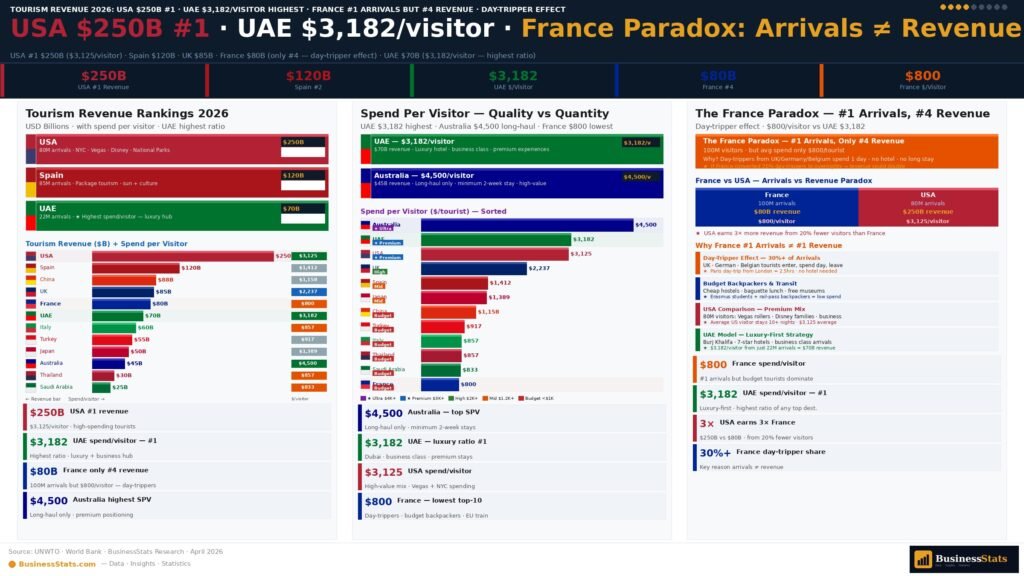
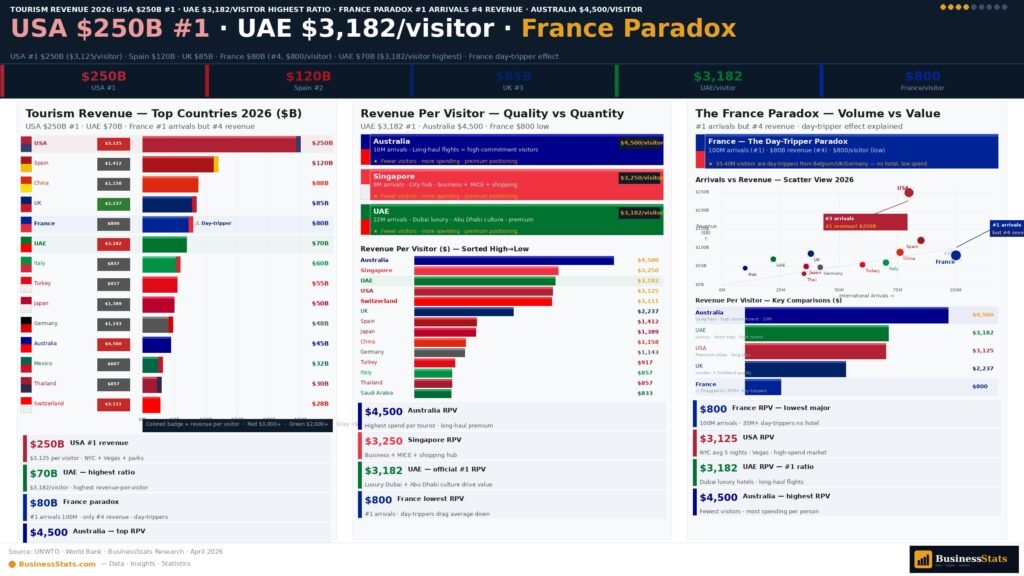
One of the most important distinctions in tourism statistics is the gap between arrivals ranking and revenue ranking. France receives more tourists than any country on Earth, yet earns only 4th most. The USA receives 20 million fewer visitors than France, yet earns three times as much. This gap reveals everything about the type of tourism each country attracts. The UAE (22M visitors, $70B revenue) earns more per visitor than any country in the top 20, reflecting Dubai's luxury positioning and high-spend visitor profile. The consumer wealth distribution driving luxury travel is analyzed in our wealth statistics report.
- USA, $250B / ~80M visitors = $3,125/visitor: Premium city pricing, long stays, high business travel spend, expensive accommodation and dining
- UAE, $70B / ~22M visitors = $3,182/visitor: Highest revenue per visitor globally · Dubai's luxury hotel, retail, and dining ecosystem captures maximum spend
- UK, $85B / ~38M visitors = $2,237/visitor: London's premium pricing, business tourism, and long-haul visitor spending
- Spain, $120B / ~85M visitors = $1,412/visitor: Strong resort package pricing, longer stays than France, all-inclusive market
- France, $80B / ~100M visitors = $800/visitor: Lowest among top earners due to high day-tripper proportion from nearby countries
Most Visited Regions & Fastest Growing Destinations
Europe dominates global tourism, accounting for approximately 44% of all international tourist arrivals (710 million) and approximately 47% of global tourism receipts. This concentration reflects Europe's exceptional density of world-class destinations within a small geographic area, its mature transport infrastructure, visa-free movement (Schengen), and strong inbound demand from North America and Asia. Asia-Pacific at 390 million arrivals is fully recovered post-COVID and is the decade's fastest-growing region. The global GDP and trade flows that make this tourism economy possible are analyzed in our global GDP analysis, while the role of Amazon and global e-commerce in travel booking is covered in our Amazon statistics.
Fastest Growing Destinations 2025 — Growth Rate by Country
Beyond the established giants, the most interesting growth stories are the emerging and recovering destinations. South Korea (+22%) is riding the Korean Wave cultural phenomenon, K-pop, K-drama, and K-beauty make Seoul one of the most digitally aspirational destinations globally. Saudi Arabia (+35%) is in a category of its own. How social media platforms drive destination choice, particularly Instagram and TikTok, is documented in our Instagram analysis and social media statistics.
Most Visited Countries — Key Statistics & Facts 2026
Frequently Asked Questions — Most Visited Countries 2026
France is the world's most visited country in 2026, receiving approximately 100 million international tourists annually. France has held this title almost continuously since the 1990s. Key attractions: Paris (Eiffel Tower, Louvre, Notre Dame), the French Riviera, Bordeaux wine region, Mont Blanc, and the Loire Valley. France is followed by Spain (~85M), USA (~80M), China (~76M), and Italy (~70M).
The United States earns the most from tourism, generating approximately $250 billion in international tourism receipts annually, far more than any other country. Despite ranking only 3rd by arrivals (~80M), the USA earns 3× more than France (#1 by arrivals). This reflects the high average spend per visitor ($3,000+), concentration of business travel, and expensive cities like New York, Los Angeles, and Miami. The revenue top 5: USA ($250B), Spain ($120B), UK ($85B), France ($80B), UAE ($70B).
France is the most visited country in both Europe and the world (~100M). Spain is Europe's second most visited (~85M) and most commercially successful tourism economy ($120B revenue). Italy is third in Europe (~70M). The UK ranks 11th globally (~38M) but 3rd by revenue ($85B). Europe collectively receives ~710 million international arrivals, 44% of the global total, with 6 of the world's top 10 most visited countries being European.
France is the world's most visited country for several reasons: (1) Paris, the world's most recognizable city brand, combining the Eiffel Tower, Louvre, fashion, and café culture; (2) Location, central in Europe, accessible by TGV from London, Brussels, Amsterdam, and Zurich, making it easy for day trips and short stays; (3) Diversity, Riviera, Alps, wine regions, medieval villages, Atlantic beaches; (4) Brand power, "France" is synonymous with luxury, cuisine, art, and romance globally; (5) Transit hub, CDG airport routes make France a first stop in Europe for many long-haul travelers.
Spain receives approximately 85 million international tourists annually in 2025/26, 2nd globally. Spain generates approximately $120 billion in tourism receipts, 2nd globally by revenue. Tourism represents approximately 13% of Spain's GDP and employs ~13% of its workforce. Key destinations: Barcelona, Madrid, Andalusia (Seville, Granada), the Balearic Islands (Mallorca, Ibiza), Canary Islands, and the Costa del Sol. The Canary Islands provide a year-round season since they remain warm in European winters.
Japan received approximately 36 million international visitors in 2025, a new national record, 60% above its 2019 high of 31.9 million. The primary driver is the Japanese yen's decline to a 34-year low against the U.S. dollar. In practical terms: a Kyoto ryokan that cost $200/night in 2019 costs approximately $130 in 2025 in USD. Combined with Japan's world-class cultural assets (Kyoto, Tokyo, Osaka), unique cuisine, and safety reputation, the price advantage has been irresistible. Over-tourism is now Japan's #1 tourism policy challenge, Kyoto has introduced temple capacity limits, Fuji has a hiking fee.
China is the most visited country in Asia by international arrivals (~76M), ranking 4th globally. Japan (~36M) holds Asia's #2 spot and broke its own national record in 2025. Thailand (~35M) is Southeast Asia's most visited country, driven by Bangkok, Phuket, and Chiang Mai. South Korea (~20M) is growing rapidly (+22% annually) powered by the Korean Wave. Other major Asian tourism markets: Malaysia (~26M), India (~20M), Indonesia, Singapore, Vietnam.
The top 5 most visited countries by international tourist arrivals in 2025/26: 1. France (~100M) · 2. Spain (~85M) · 3. USA (~80M) · 4. China (~76M) · 5. Italy (~70M). This ranking has been broadly stable for decades. Turkey (~60M) and Mexico (~45M) compete for positions 6–7. Japan (~36M) has recently broken into the top 10 with record 2025 arrivals. Saudi Arabia is the fastest-growing new entrant, counting ~100M visitors including religious pilgrimage.
Saudi Arabia has the fastest growing tourism sector of any significant destination, with arrivals growing approximately 35% annually as the Kingdom executes its Vision 2030 tourism agenda. In terms of absolute new visitors, Japan had the largest single surge in 2025 (+~5 million new visitors vs 2024). Among regions, the Middle East leads at +22% arrivals growth. South Korea (+22%) and India (+14%) are other standouts among larger destinations.
There is often a major gap between a country's arrivals ranking and its revenue ranking. France (#1 arrivals, ~100M) ranks 4th by revenue (~$80B), $800/visitor, because many visitors are day-trippers from neighboring countries spending little. The USA (#3 arrivals, ~80M) ranks #1 by revenue ($250B), $3,125/visitor, because visitors stay longer, spend more, and pay U.S. premium prices. The UAE has the world's highest revenue/visitor ratio (~$3,182) despite ranking only 15th by arrivals. The revenue ranking is a better measure of economic value of tourism than the arrivals ranking.
Tourism's share of GDP varies dramatically: Maldives (~60%), most tourism-dependent nation on Earth; Iceland (~35%); Greece (~20%); Portugal (~15%); Spain and Italy (~13% each); France (~7%); USA (~3% international, ~8% total). Countries where tourism dominates are significantly more vulnerable to shocks, the Maldives lost approximately 60% of GDP in 2020 when tourism stopped. The flip side: tourism is often these nations' fastest path to economic development, providing jobs and foreign currency that other sectors cannot.
Turkey ranks approximately 6th globally by international tourist arrivals, receiving approximately 60 million visitors annually in 2025/26. Turkey has grown dramatically from ~25 million visitors in 2010, one of the most sustained tourism growth stories of any major country. Revenue: approximately $52 billion. Key drivers: lira weakness making Turkey very affordable; Istanbul's unique Eurasian cultural positioning; Antalya's Mediterranean beach resorts; and strong inbound demand from Russia, Germany, UK, and CIS countries.
Italy receives approximately 70 million international tourists annually in 2025/26, ranking 5th globally. Tourism revenue: approximately $60 billion. Tourism represents approximately 13% of Italian GDP. Key destinations: Rome (Colosseum, Vatican, Trevi Fountain), Venice, Florence (Uffizi, David), the Amalfi Coast, Sicily, and Tuscany. Italy faces significant over-tourism at its most iconic sites: Venice has introduced a €5 day-tripper fee (the first major city globally to do so), and crowd management at Rome's major monuments is increasingly managed.
The United States receives approximately 80 million international visitors annually in 2025/26, ranking 3rd globally by arrivals but 1st by tourism revenue at $250 billion. Most visited U.S. cities by international tourists: New York City (~13M), Los Angeles (~7M), Miami (~6M), Orlando (~5M), Las Vegas (~5M). The USA's domestic tourism market is even larger at approximately $1.1 trillion annually, the world's largest domestic tourism market. Total U.S. tourism (domestic + international) is approximately $1.35 trillion, approximately 8% of U.S. GDP.
Saudi Arabia's Vision 2030 tourism agenda aims to make tourism a cornerstone of economic diversification away from oil. Key targets: 150 million visitors annually by 2030 (from ~100M in 2025), tourism contributing 10% of GDP (from ~7% currently). Key projects: NEOM (a $500B futuristic mega-city), AlUla (heritage/UNESCO site marketed as "world's largest open-air museum"), Red Sea Project (luxury eco-resort islands), Diriyah (historic heritage site), and Qiddiya (massive entertainment city near Riyadh). Saudi Arabia's e-visa program (launched 2019) opened the Kingdom to tourists from 49 countries, the key policy unlock that triggered the growth surge.
Supporting: National tourism board annual reports, France Tourism (Atout France), Turespaña, Brand USA, JNTO (Japan), Enit (Italy), Turkish Ministry of Culture & Tourism, Tourism Authority of Thailand, Korea Tourism Organization
Supporting: World Bank, International Tourism, Number of Arrivals (ST.INT.ARVL) · Historical series by country