
World's Largest Countries by Area — Complete 2026 Overview
The distribution of land area among the world's 195 sovereign nations is extraordinarily unequal. The single largest country — Russia — covers more land than the entire continent of Antarctica, more than the combined area of the United States and China together, and nearly twice the area of Canada (the second-largest country). At the other extreme, Vatican City covers just 0.44 km² — smaller than many city parks and visible in its entirety from the dome of St. Peter's Basilica. This 39-million-to-one size ratio between the largest and smallest countries is one of the most striking statistical extremes in human geography.
Understanding country size is fundamental to understanding geopolitics, economics, and human development. For the political dimension see our politics and government statistics. Large countries tend to have greater natural resource endowments, more diverse climatic zones, and greater strategic depth — but also face unique governance challenges in managing vast territories with dispersed populations. The relationship between size and prosperity is not linear: Australia (6th largest) has a GDP per capita of $55,000+, while the Democratic Republic of Congo (12th largest) has a GDP per capita of under $600. Size is a necessary but not sufficient condition for great power status. For broader economic context see our global financial markets statistics.
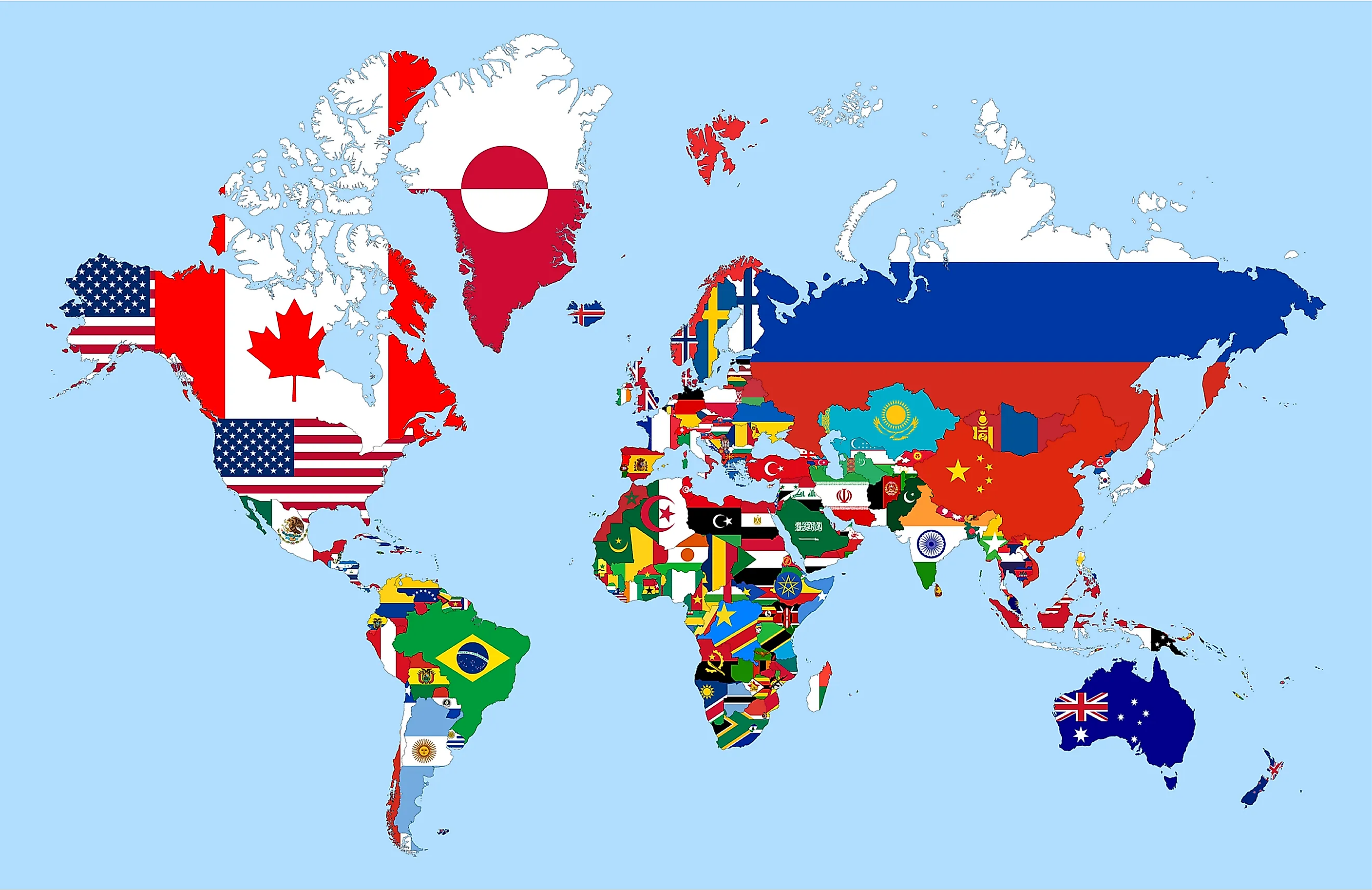
How Country Area is Measured
Country area statistics require careful definition. The most commonly cited figure — "total area" — typically includes both land area and inland water bodies (lakes, rivers, reservoirs within the country's borders). This is why Canada's total area (9,984,670 km²) appears large relative to its land-only area (9,093,507 km²) — Canada contains an extraordinary number of lakes, including several of the world's largest. The United States similarly has a significant difference between total area (9,833,517 km²) and land area (9,147,593 km²) due to the Great Lakes (shared with Canada) and other large inland water bodies.
A separate and politically significant measurement is the Exclusive Economic Zone (EEZ) — the maritime zone extending 200 nautical miles from a country's coast in which it has exclusive rights to marine resources. By EEZ, the rankings change dramatically: France has one of the world's largest EEZs (11.7 million km²) due to its extensive overseas territories in the Pacific, Atlantic, and Indian Oceans — making it larger than Russia by maritime area. The United States EEZ (11.4 million km²) similarly exceeds Russia's EEZ. EEZ size is increasingly important economically due to deep-sea mining, offshore wind energy, and fishing rights.
Top 10 Largest Countries by Area — Animated Chart
The chart below shows the top 10 largest countries by total area in million km². The size differential between Russia (#1, 17.1M km²) and Algeria (#10, 2.38M km²) is more than 7:1 — Russia is more than seven times larger than the 10th-largest country in the world. The first five countries (Russia, Canada, USA, China, Brazil) all exceed 8 million km² and collectively control approximately 38% of all land on Earth.
Top 50 Largest Countries in the World — Complete Ranking with km² and Square Miles
The sortable table below lists the 50 largest sovereign countries in the world with their total area in both km² and square miles, continent, and percentage of world land area. Click any column header to sort. The top 50 countries cover approximately 93% of all land on Earth — the remaining 145 countries share just 7% of global land area.
| Rank | Country | Continent | Area (km²) | Area (mi²) | % of World |
|---|---|---|---|---|---|
| 1 | Russia | Europe/Asia | 17,098,242 | 6,601,668 | 11.5% |
| 2 | Canada | North America | 9,984,670 | 3,855,103 | 6.7% |
| 3 | United States | North America | 9,833,517 | 3,796,742 | 6.6% |
| 4 | China | Asia | 9,596,960 | 3,705,407 | 6.4% |
| 5 | Brazil | South America | 8,515,767 | 3,287,956 | 5.7% |
| 6 | Australia | Oceania | 7,692,024 | 2,969,907 | 5.2% |
| 7 | India | Asia | 3,287,263 | 1,269,219 | 2.2% |
| 8 | Argentina | South America | 2,780,400 | 1,073,520 | 1.9% |
| 9 | Kazakhstan | Asia | 2,724,900 | 1,052,090 | 1.8% |
| 10 | Algeria | Africa | 2,381,741 | 919,595 | 1.6% |
| 11 | DR Congo | Africa | 2,344,858 | 905,354 | 1.6% |
| 12 | Saudi Arabia | Asia | 2,149,690 | 830,000 | 1.4% |
| 13 | Mexico | North America | 1,964,375 | 758,450 | 1.3% |
| 14 | Indonesia | Asia | 1,904,569 | 735,358 | 1.3% |
| 15 | Sudan | Africa | 1,861,484 | 718,723 | 1.3% |
| 16 | Libya | Africa | 1,759,540 | 679,362 | 1.2% |
| 17 | Iran | Asia | 1,648,195 | 636,372 | 1.1% |
| 18 | Mongolia | Asia | 1,564,116 | 603,909 | 1.1% |
| 19 | Peru | South America | 1,285,216 | 496,225 | 0.9% |
| 20 | Chad | Africa | 1,284,000 | 495,755 | 0.9% |
| 21 | Niger | Africa | 1,267,000 | 489,191 | 0.9% |
| 22 | Angola | Africa | 1,246,700 | 481,354 | 0.8% |
| 23 | Mali | Africa | 1,240,192 | 478,841 | 0.8% |
| 24 | South Africa | Africa | 1,221,037 | 471,445 | 0.8% |
| 25 | Colombia | South America | 1,141,748 | 440,831 | 0.8% |
| 26 | Ethiopia | Africa | 1,104,300 | 426,373 | 0.7% |
| 27 | Bolivia | South America | 1,098,581 | 424,164 | 0.7% |
| 28 | Mauritania | Africa | 1,030,700 | 397,955 | 0.7% |
| 29 | Egypt | Africa | 1,002,450 | 387,048 | 0.7% |
| 30 | Tanzania | Africa | 945,087 | 364,900 | 0.6% |
| 31 | Nigeria | Africa | 923,768 | 356,669 | 0.6% |
| 32 | Venezuela | South America | 912,050 | 352,144 | 0.6% |
| 33 | Namibia | Africa | 824,292 | 318,261 | 0.6% |
| 34 | Mozambique | Africa | 801,590 | 309,496 | 0.5% |
| 35 | Pakistan | Asia | 796,095 | 307,374 | 0.5% |
| 36 | Turkey | Asia/Europe | 783,562 | 302,535 | 0.5% |
| 37 | Chile | South America | 756,102 | 291,930 | 0.5% |
| 38 | Zambia | Africa | 752,618 | 290,585 | 0.5% |
| 39 | Myanmar | Asia | 676,578 | 261,228 | 0.5% |
| 40 | Afghanistan | Asia | 652,230 | 251,827 | 0.4% |
| 41 | Somalia | Africa | 637,657 | 246,201 | 0.4% |
| 42 | Central African Rep. | Africa | 622,984 | 240,535 | 0.4% |
| 43 | South Sudan | Africa | 619,745 | 239,285 | 0.4% |
| 44 | Ukraine | Europe | 603,550 | 233,062 | 0.4% |
| 45 | Madagascar | Africa | 587,041 | 226,658 | 0.4% |
| 46 | Botswana | Africa | 581,730 | 224,607 | 0.4% |
| 47 | Kenya | Africa | 580,367 | 224,081 | 0.4% |
| 48 | France | Europe | 551,695 | 213,011 | 0.4% |
| 49 | Yemen | Asia | 527,968 | 203,850 | 0.4% |
| 50 | Thailand | Asia | 513,120 | 198,115 | 0.3% |
Largest Countries by Continent — Regional Rankings
Largest Country per Continent
Africa is home to the most large countries by count — 4 countries in the top 20 (Algeria, DR Congo, Sudan, Libya) and 9 countries in the top 50. Despite this, Africa's largest country (Algeria, 2.38M km²) is dwarfed by Russia. Africa's total land area of approximately 30.3 million km² makes it the second-largest continent. Asia is the largest continent at 44.6 million km² and contains massive countries including China (9.6M km²), Kazakhstan (2.7M km²), Saudi Arabia (2.1M km²), and Indonesia (1.9M km²). Europe is the smallest continent by area (excluding Antarctica) at approximately 10.5 million km², with Russia as its largest country if the European portion is counted separately. France (551,695 km²) is the largest purely European-territory country.
North America features two of the world's three largest countries (Canada and USA) plus Mexico (13th globally). South America's largest country is Brazil — the only country in the top 5 that is neither English-speaking nor shares a land border with Russia. Brazil alone accounts for 47% of South America's total land area. Australia is both a country and a continent — the only nation to occupy an entire continent. At 7.69 million km², it is larger than all of Europe.

Russia — 17.1 Million km² Explained: The World's Largest Country by a Massive Margin
Russia's extraordinary size — 17,098,242 km² — defies easy comprehension. To contextualise it: Russia is larger than Pluto's surface area (17.6M km² — close, but Pluto is slightly larger); it spans 11 time zones (when you board a flight from Vladivostok in the east, it is already the next day in Moscow); its west-to-east extent of approximately 9,000 km is greater than the distance from London to Los Angeles; and it shares land borders with 14 different countries — more than any other nation on Earth. Russia's northern coastline along the Arctic Ocean stretches approximately 37,000 km, giving it the world's longest Arctic coastline and access to enormous untapped resource deposits as Arctic ice melts due to climate change.
Russia's vast size is the result of centuries of imperial expansion. The Russian state began as the Grand Duchy of Muscovy — a relatively small territory centred on Moscow — in the 14th century. Through a combination of military conquest, diplomatic absorption of neighbouring khanates, and exploration of Siberia, Russia expanded eastward across the Ural Mountains and into Central Asia and the Far East. By the 17th century, Russia had reached the Pacific Ocean. At its imperial peak in the 19th century, the Russian Empire stretched from Poland to Alaska — the latter sold to the United States in 1867 for $7.2 million ($0.02 per acre). Today's Russia, even after the Soviet Union's dissolution in 1991 (which created 14 new independent states), remains nearly twice the size of any other country.
Largest Territories and Dependencies — Non-Sovereign Areas by Size
Beyond the 195 sovereign nations, the world contains numerous dependent territories, overseas departments, and autonomous regions with significant land areas. The largest of these is Greenland — an autonomous territory of Denmark with 2,166,086 km², which would rank as the 12th-largest sovereign nation if independent. Greenland's strategic importance has grown dramatically as Arctic ice melts, revealing potential oil, gas, and mineral deposits. (US President Donald Trump's 2025 renewed interest in purchasing Greenland from Denmark — initially floated in his first term — reflects its growing geopolitical significance.)
| Rank | Territory | Area km² | Status | Administered by |
|---|---|---|---|---|
| 1 | Greenland | 2,166,086 | Autonomous territory | Denmark |
| 2 | Antarctica (unclaimed) | ~1,610,000 | International territory | Antarctic Treaty |
| 3 | Western Sahara | 266,000 | Disputed territory | Morocco (de facto) |
| 4 | New Caledonia | 18,575 | Special collectivity | France |
| 5 | French Guiana | 83,534 | Overseas department | France |
| 6 | Alaska (US state) | 1,723,337 | US state | United States |
| 7 | Nunavut (Canada) | 2,093,190 | Canadian territory | Canada |
| 8 | Tibet (Xizang) | 1,228,400 | Autonomous region | China |
| 9 | Xinjiang | 1,664,897 | Autonomous region | China |
| 10 | Sahara (Western) | 9,200,000 | Desert region (multi-country) | Various |
The World's Smallest Countries by Area — From Vatican City to Malta
The world's smallest countries are as fascinating as the largest — microstates that have survived centuries of geopolitical change by carving out unique niches as financial centres, tourism destinations, or diplomatic entities. Vatican City (0.44 km²) is the smallest internationally recognised sovereign state in both area and population (~800 people) — an independent nation that fits entirely within Rome and is governed by the Pope as an absolute monarchy. Vatican City has no standing army, produces no food, and relies entirely on Italy for utilities and physical security (though the Swiss Guard has protected the Pope since 1506).
Monaco (2.02 km²) is smaller than New York's Central Park (3.41 km²) yet is a fully sovereign nation with its own government, monarch (Prince Albert II), football team, Formula 1 Grand Prix, and the world's highest GDP per capita at approximately $185,000 per person. Monaco's economic model — luxury tourism, casino revenues, financial services, and zero income tax attracting ultra-high-net-worth residents — demonstrates that sovereign territory size has essentially no relationship to economic sophistication or prosperity. Monaco's population density of approximately 26,000 people per km² makes it the most densely populated sovereign nation on Earth.
Country Size vs Population — The Largest Countries Are Not the Most Populous
The chart below illustrates a fundamental geographic paradox: the world's largest countries by area are not the most populous. Russia covers 11.5% of world land but holds only 1.8% of world population. Canada covers 6.7% of world land but holds only 0.5% of world population. The sparsely populated large countries (Russia, Canada, Australia, Kazakhstan, Mongolia) have population densities of 2-4 people per km² — while small, densely populated nations like Bangladesh (1,326 per km²) and the Netherlands (508 per km²) pack far more people into far less space. India — the 7th largest country — is now the world's most populous nation (1.45 billion) while Australia — the 6th largest — has just 27 million people.
How Country Size Has Changed — Border Changes Since 1900
Modern country borders are far more stable than historical borders, but significant changes have occurred even in the 20th and 21st centuries. The dissolution of the Soviet Union in 1991 created 15 new countries and reduced Russia's official territory (though Russia remains the world's largest). Sudan's partition in 2011 created South Sudan — making both Sudan and South Sudan separately appear in the top 50 largest countries. Kosovo declared independence from Serbia in 2008 (partially recognised). Most recently, Russia's 2022 invasion of Ukraine and subsequent claimed annexations of four Ukrainian oblasts (Donetsk, Luhansk, Zaporizhzhia, Kherson) represent the most significant attempted forced border change in Europe since World War II — not recognised by the UN General Assembly (which voted 143-5 against the annexation). For political context see our politics and government statistics.
World's Largest Countries — Historical Size Changes & Population Growth 1950–2026
The chart below tracks four key trends for the world's largest countries from 1950 to 2026: Russia's population (declining since 1990), USA population growth, China's population (peaking and now declining), and India's population — which overtook China as the world's most populous country in 2023. This chart illustrates the fundamental geographic paradox: the largest countries are not the most populous, and the most populous are not the fastest-growing economically. The correlation between land area and economic output is weak — Australia (6th largest by area) has a GDP per capita 90x larger than DR Congo (11th largest by area). For economic data see our global financial markets statistics.
Largest Countries in the World — Key Facts & Numbers
Frequently Asked Questions — Largest Countries by Area
Russia at 17,098,242 km² (6,601,668 sq mi) — covering 11.5% of all land on Earth. Russia spans 11 time zones, shares borders with 14 countries, and is nearly twice the size of second-place Canada (9,984,670 km²). Russia is larger than the entire continent of Antarctica and bigger than the USA and China combined.
1. Russia (17.1M km²) 2. Canada (9.98M km²) 3. USA (9.83M km²) 4. China (9.6M km²) 5. Brazil (8.5M km²) 6. Australia (7.69M km²) 7. India (3.29M km²) 8. Argentina (2.78M km²) 9. Kazakhstan (2.72M km²) 10. Algeria (2.38M km²). These 10 countries cover approximately 49% of all land on Earth.
Vatican City at just 0.44 km² (110 acres) — smaller than many city parks. Located entirely within Rome, Italy. The 5 smallest: Vatican City (0.44 km²), Monaco (2.02 km²), San Marino (61 km²), Liechtenstein (160 km²), Malta (316 km²). All 5 are in Europe.
11.5% of the world's total land area of 148.9 million km². Russia spans two continents (Europe and Asia), 11 time zones, and has a coastline longer than any other country. It is roughly the size of the surface of Pluto and contains the world's largest forest (taiga/boreal forest at ~12 million km²).
By single country: Russia (Europe/Asia). By total continental land: Asia (44.6M km²) is the largest continent. Africa has the most large countries in the top 50, with 21 entries. North America has the most top-5 entries (Canada #2, USA #3). Australia is the only country that is also an entire continent.
Greenland (2,166,086 km²) is an autonomous territory of Denmark — not a sovereign country. If it were independent, it would rank as the 12th largest country in the world, larger than Saudi Arabia. Its population is just ~56,000 — the lowest population density of any non-Antarctic territory on Earth (~0.026 people per km²). Greenland's strategic Arctic position has made it a geopolitical focus in recent years.
Earth's total land area is approximately 148.9 million km² (57.5 million sq mi), representing 29.2% of Earth's total surface area of 510 million km². The remaining 70.8% (361 million km²) is water. The Pacific Ocean alone (165 million km²) is larger than all land on Earth combined.
Primary: UN Statistics Division — Country Area Data
Primary: CIA World Factbook 2026
Primary: World Bank — Land Area (sq km)
Additional: ISO 3166 Country Codes · National Geographic Atlas of the World · Encyclopaedia Britannica Country Data · USGS Geographic Names Information System