
The Global Oil Refinery Industry in 2026: 103 Million Barrels of Daily Capacity, a $180 Billion Margin Pool, and a Structural East-West Shift
The oil refining industry occupies the critical middle position in the petroleum value chain, transforming raw crude oil into the refined products that power transportation, heat buildings, fuel industrial processes, and provide the essential feedstocks for the global petrochemical industry. Every barrel of crude oil extracted from the ground must pass through a refinery before it becomes useful to the end consumer, making the refining sector an indispensable link between the upstream oil production industry (explored in comprehensive detail in our analysis of the $3.3 trillion global oil industry) and the downstream distribution networks that deliver gasoline to service stations, diesel to trucking fleets, jet fuel to airports, and naphtha to petrochemical crackers.
In 2025, the global refining industry operated approximately 650+ refineries across over 120 countries, with a combined nameplate (distillation) capacity of approximately 103.3 million bbl/d. Actual crude oil throughput, the amount of crude oil processed by refineries, averaged approximately 82–84 million bbl/d, representing a global utilization rate of approximately 80–82%. This utilization rate is below the industry's "sweet spot" of 85–90% (which maximizes margins by creating product supply tightness) due to a combination of planned maintenance turnarounds, unplanned outages, OPEC+ production restraint limiting crude availability, and the permanent closure of less competitive refineries. The gap between nameplate capacity (103.3M) and actual throughput (82–84M) represents approximately 20 million bbl/d of "effective spare capacity," though much of this is in mothballed, poorly maintained, or economically unviable facilities rather than genuinely deployable capacity.
The refining industry is currently undergoing the most significant geographic rebalancing in its modern history. Since 2020, approximately 3.5 million bbl/d of refining capacity has been permanently closed, primarily in developed markets: Europe (closures at Grandpuits/France, Wesseling/Germany, Fredericia/Denmark, and multiple smaller plants), Japan (ongoing rationalization from 4.5M to 3.2M bbl/d as population declines reduce fuel demand), Australia (three of four refineries closed since 2020, leaving only Geelong operational), and the United States (several smaller Gulf Coast and East Coast refineries). Simultaneously, approximately 6+ million bbl/d of new capacity is under construction or recently commissioned in Asia and the Middle East: Nigeria's Dangote refinery (650,000 bbl/d, Africa's largest, commissioned 2024), China's Yulong petrochemical complex (400,000 bbl/d), Kuwait's Al-Zour refinery (615,000 bbl/d, commissioned 2023), Saudi Arabia's Jazan refinery (400,000 bbl/d), and India's planned Ratnagiri mega-refinery (1.2 million bbl/d, the world's largest single-site refinery if completed). This West-to-East shift reflects the fundamental reality that petroleum product demand growth is concentrated entirely in Asia and Africa, while demand in Europe, Japan, and increasingly North America is flat or declining.
The economics of refining have been exceptionally volatile in the post-2020 period. Refining margins (crack spreads) collapsed during the COVID-19 pandemic in 2020, when gasoline and jet fuel demand evaporated while crude oil storage filled to capacity, pushing some refiners to negative margins. The post-COVID recovery and the Russia-Ukraine war of 2022 created extraordinary conditions: the loss of approximately 1.5 million bbl/d of Russian refined product exports to Europe (following EU sanctions) tightened global product supply dramatically, pushing refining margins to record levels of $25–35 per barrel in mid-2022, compared to a historical average of $8–10/bbl. By 2025, margins had normalized to approximately $12–15/bbl, still above historical averages but well below the 2022 supercycle peak. The relationship between crude oil prices, refining margins, and end-consumer fuel prices is explored in comprehensive analysis of US and global energy price dynamics.
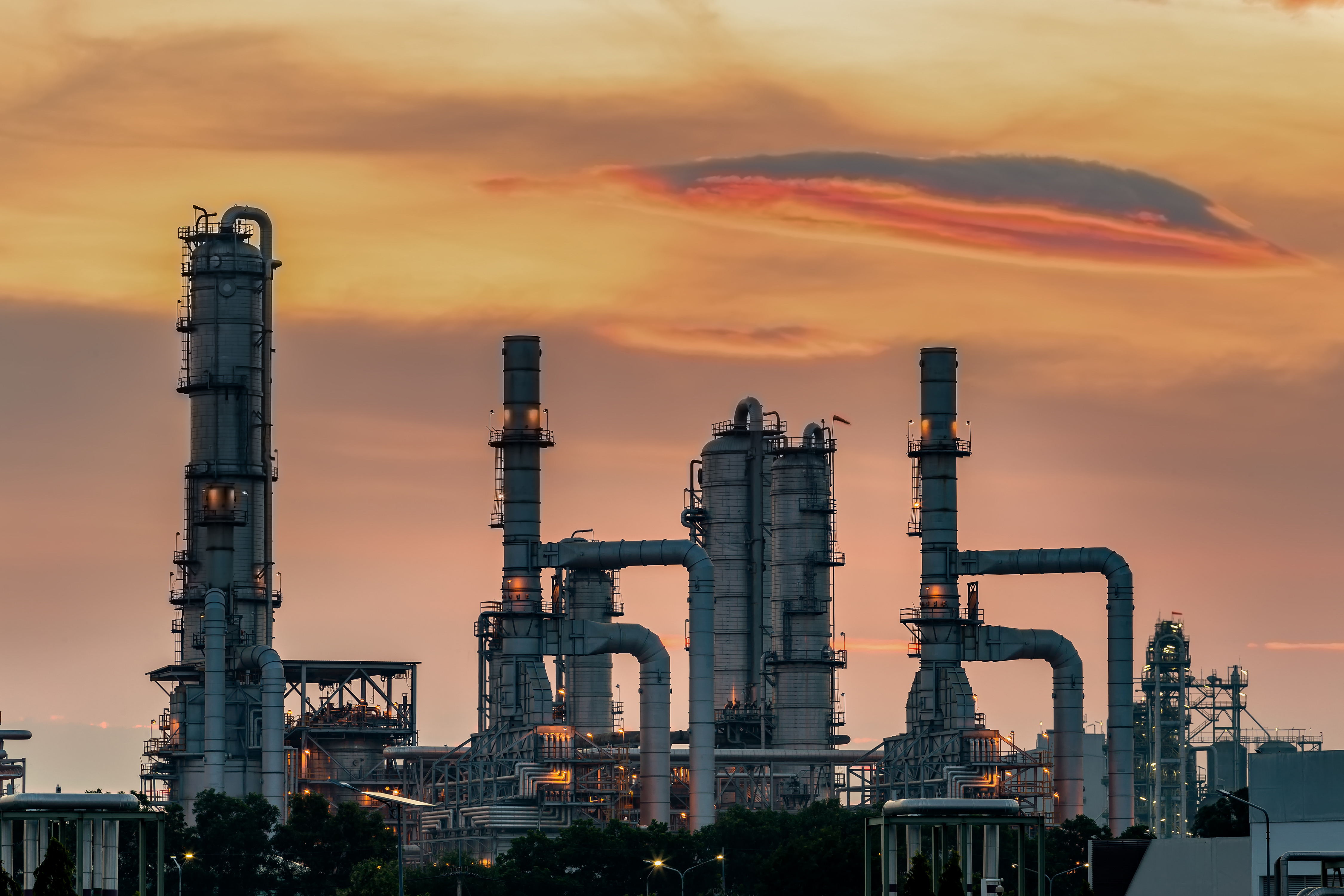
Global Refining Capacity by Year — 2000 to 2030*
The bar chart below illustrates the evolution of global refining nameplate capacity from 2000 to 2026 with projections to 2030. Global capacity has grown from approximately 82 million bbl/d in 2000 to 103.3 million bbl/d in 2025, a CAGR of approximately 0.9%. The growth has been entirely driven by Asia (particularly China and India) and the Middle East, while North American capacity has remained roughly flat and European capacity has declined. The 2020–2021 period marked the first net global capacity decline in modern history, as COVID-related closures outpaced new additions. The 2030 projection of 107–110 million bbl/d reflects a slowing growth rate as the energy transition reduces long-term fuel demand growth.
The capacity figures require careful interpretation. Nameplate capacity represents the maximum crude distillation unit (CDU) throughput under ideal conditions, but actual operational capacity is typically 5–10% lower due to maintenance, crude quality limitations, and downstream unit bottlenecks. Furthermore, not all refining capacity is equal: a simple "topping" refinery (which merely distills crude into basic fractions) is fundamentally different from a complex "deep conversion" refinery (which includes catalytic crackers, hydrocrackers, cokers, and reformers that maximize the yield of high-value light products like gasoline and diesel from heavy, sour crude oils). The industry measures refinery sophistication using the Nelson Complexity Index (NCI): a simple topping refinery has an NCI of 2–3, while the most complex refineries (such as Reliance's Jamnagar at NCI 21.1 or ExxonMobil's Baytown at NCI 15.3) score 15+. Higher complexity generally means higher margins because the refinery can process cheaper heavy crude and produce a larger proportion of valuable light products.
Refining Capacity by Country — Top 15 Nations 2025
The following table presents the world's 15 largest refining nations by nameplate capacity, including throughput, number of refineries, average utilization rate, and the key context for each country's refining sector. The United States leads globally at 18.4 million bbl/d across 130+ refineries, concentrated along the Gulf Coast (Texas, Louisiana) which accounts for approximately 55% of US capacity. China's rapid capacity expansion from 8 million bbl/d in 2005 to 17.5 million bbl/d in 2025 makes it the world's second-largest refining nation, though significant overcapacity (utilization approximately 72%) and a government-mandated consolidation of smaller "teapot" refineries are ongoing challenges.
| Rank | Country | Capacity (M bbl/d) | Refineries | Utilization | Key Context |
|---|---|---|---|---|---|
| 1 | United States | 18.4 | 130+ | ~90% | Gulf Coast dominant, exports growing |
| 2 | China | 17.5 | 70+ | ~72% | Overcapacity, teapot consolidation |
| 3 | Russia | 6.3 | 40+ | ~75% | Sanctions divert exports to Asia |
| 4 | India | 5.8 | 23 | ~95% | Jamnagar world's largest, export hub |
| 5 | South Korea | 3.4 | 6 | ~88% | SK/GS Caltex, export-oriented |
| 6 | Japan | 3.2 | 21 | ~78% | Declining, population-driven cuts |
| 7 | Saudi Arabia | 3.1 | 9 | ~85% | Aramco expansion, fuels-to-chemicals |
| 8 | Brazil | 2.4 | 15 | ~82% | Petrobras dominant, biofuel blend |
| 9 | Iran | 2.2 | 10 | ~80% | Sanctions limit modernization |
| 10 | Germany | 2.0 | 12 | ~82% | Largest EU refiner, declining demand |
| 11 | Kuwait | 1.4 | 3 | ~88% | Al-Zour new 615K bbl/d refinery |
| 12 | UAE | 1.2 | 4 | ~90% | ADNOC Ruwais expansion |
| 13 | Italy | 1.8 | 11 | ~76% | Mediterranean trading hub |
| 14 | Nigeria | 0.9 | 5 | ~55% | Dangote 650K bbl/d transformative |
| 15 | Canada | 1.9 | 14 | ~85% | Oil sands upgraders, Alberta focus |
Global Refining Margins vs. Crude Oil Price — 2010 to 2026
The line chart below tracks the relationship between average global refining margins (gold line, 3-2-1 crack spread basis) and Brent crude oil prices (blue line) from 2010 to 2026. The key insight is that refining margins are not directly correlated with crude oil prices: margins are driven by the tightness of refined product supply relative to demand, not by the absolute level of crude oil prices. The 2022 margin spike ($25–35/bbl) occurred when Russian product sanctions removed approximately 1.5 million bbl/d of refined products from European markets while refinery closures during COVID had already reduced global processing capacity. The normalization to $12–15/bbl in 2024–2025 reflects new capacity additions (Dangote, Al-Zour) and demand moderation in developed markets.
World's 10 Largest Oil Refineries by Capacity — 2025 Rankings
The ranking of the world's largest refineries reveals the dominant role of Asian and Middle Eastern facilities in modern refining. Seven of the world's ten largest refineries are located in Asia or the Middle East. Reliance Industries' Jamnagar complex in Gujarat, India, is the undisputed global leader at 1.36 million bbl/d of combined capacity, a facility so large that it can be seen from space and processes more crude oil daily than the entire national consumption of many medium-sized countries. The Middle East's expanding role in downstream petroleum processing is detailed in comprehensive analysis of the Middle Eastern oil industry's $1.1 trillion ecosystem, where nations like Saudi Arabia, Kuwait, and the UAE are strategically investing in refining capacity to capture more value from their crude oil production rather than exporting raw barrels.
The scale economics of modern refineries strongly favor consolidation into mega-facilities. A world-scale refinery of 400,000+ bbl/d capacity achieves unit processing costs approximately 30–40% lower than a 100,000 bbl/d facility due to engineering economies of scale in heat exchange, catalytic cracking, hydrogen production, and utility systems. This is why new refinery construction is almost exclusively at world-scale or larger: the Dangote refinery in Nigeria (650,000 bbl/d), Kuwait's Al-Zour (615,000 bbl/d), and India's proposed Ratnagiri mega-refinery (1.2 million bbl/d) are all designed to achieve minimum efficient scale. Smaller refineries in developed markets that cannot match these economics are being systematically closed or converted to biofuel processing facilities.
World's 10 Largest Refineries by Capacity — 2025
Refining Capacity by Region — Asia-Pacific Now Leads the World
The geographic distribution of global refining capacity has shifted dramatically over the past two decades. Asia-Pacific now holds approximately 37.2 million bbl/d of capacity (36% of global), having overtaken North America as the world's largest refining region. North America holds approximately 22.1 million bbl/d (21%), dominated by the US Gulf Coast. Europe holds approximately 14.5 million bbl/d (14%) but is declining as closures outpace any new investment. The Middle East holds approximately 10.8 million bbl/d (10%) and is the fastest-growing region by percentage. Russia & CIS account for approximately 8.5 million bbl/d (8%), while Africa (3.5M, 3.4%) and Latin America (7.7M, 7.5%) complete the picture.
This regional shift reflects fundamental changes in global petroleum product demand patterns. Gasoline demand in the United States peaked in 2018 at approximately 9.3 million bbl/d and has been declining slowly since then, driven by improving fuel economy standards (CAFE regulations targeting 49 mpg by 2026 for new vehicles) and the gradual penetration of electric vehicles. European diesel demand has been declining since 2015 as the continent reverses its decades-long "dieselization" policy following the Volkswagen emissions scandal. Japanese petroleum consumption has declined approximately 2% annually for over a decade as population shrinks and efficiency improves. In contrast, India's petroleum demand is growing at 4–5% annually (the fastest of any major economy), driven by a rapidly growing middle class acquiring their first automobiles, expanding aviation, and accelerating industrialization. China's demand growth has slowed to 1–2% annually but continues to grow in petrochemicals and aviation fuel even as EV adoption reduces gasoline demand growth.
The US Gulf Coast refining complex deserves particular attention as the world's most competitive refining hub. The concentration of approximately 55% of US refining capacity (over 10 million bbl/d) along the Texas and Louisiana Gulf Coast creates extraordinary economies of agglomeration: shared pipeline infrastructure for crude delivery (from the Permian Basin, Eagle Ford, and waterborne imports), shared export terminals (Houston Ship Channel, Corpus Christi, Lake Charles), a deep labor pool of skilled refinery operators and engineers, integrated petrochemical complexes (Houston is the world's largest petrochemical production center), and proximity to both domestic and export markets. Gulf Coast refiners benefit from access to discounted domestic crude oil (WTI typically trades at $2–5/bbl below Brent, providing a structural cost advantage versus European and Asian refiners), making the US Gulf Coast the world's lowest-cost refining region alongside the Middle East. This cost advantage has transformed the United States from a net importer of refined products (importing approximately 3 million bbl/d as recently as 2005) to a significant net exporter (exporting approximately 3.5–4 million bbl/d of refined products in 2025, primarily diesel and gasoline to Latin America and Europe).
The Middle East's refining expansion represents a strategic pivot by Gulf oil-producing nations from exporting raw crude oil to exporting higher-value refined products and petrochemicals. Saudi Arabia, the UAE, Kuwait, Oman, and Bahrain have collectively added approximately 2 million bbl/d of refining capacity since 2015, with another 1+ million bbl/d under development. This downstream integration strategy serves multiple objectives: it captures the "value-added margin" between crude oil and product prices (approximately $10–15/bbl), creates skilled employment for citizens as part of economic diversification, reduces domestic dependence on imported petroleum products, and strengthens the nations' positions in global energy markets by offering customers integrated crude-plus-products supply packages. The Middle East's refining expansion is detailed in comprehensive analysis of the Middle Eastern oil industry's $1.1 trillion petroleum ecosystem.
What Do Oil Refineries Produce? The Barrel Breakdown and Product Economics
A barrel of crude oil (42 US gallons, approximately 159 liters) enters a refinery as a complex mixture of thousands of hydrocarbon compounds and exits as a slate of refined products, each serving different end markets. The refinery's "product yield" describes the percentage of each output product from a barrel of input crude. The exact yield depends on three variables: the quality of crude oil input (light/sweet crudes like Brent and WTI yield more gasoline and diesel naturally, while heavy/sour crudes like Arab Heavy and Canadian oil sands bitumen require more processing), the refinery's complexity (more complex refineries can convert a larger proportion of heavy fractions into light products), and seasonal/market demand (refineries adjust operations to maximize production of whichever product commands the highest margin at any given time).
A typical US Gulf Coast refinery processing medium sour crude produces approximately: 45% gasoline and motor fuels (19 gallons per barrel, the single most valuable output in the US market), 25% diesel and heating oil (11 gallons, the most valuable product in European and Asian markets where diesel demand is higher), 10% jet fuel/kerosene (4 gallons, the fastest-growing product category globally due to aviation expansion), 4% liquefied petroleum gas (LPG/propane/butane), 4% residual fuel oil (declining in value due to IMO 2020 marine fuel sulfur regulations), 3% petrochemical feedstock (naphtha and ethylene, the fastest-growing end use), and 9% other products (asphalt, lubricating oils, petroleum coke, waxes, sulfur). The total volume of products produced actually exceeds the input volume by approximately 5–7% due to "processing gain," the reduction in density that occurs when heavy hydrocarbons are cracked into lighter molecules.
The relative value of different refined products varies significantly by region and season, creating complex optimization challenges for refinery operators. In the United States, gasoline commands a premium during the summer driving season (May–September), when the so-called "gasoline crack" (the margin between crude oil cost and gasoline selling price) typically widens by $3–5/bbl compared to winter. In Europe and Asia, where diesel vehicles are more prevalent and industrial activity drives gasoil demand, the "diesel crack" is the primary margin driver. Jet fuel (kerosene) is the fastest-growing refined product globally, driven by the post-COVID recovery in air travel and the structural growth of aviation in emerging markets, particularly Asia-Pacific. Modern complex refineries can adjust their product slate within approximately 5–10% to maximize production of whichever product offers the highest margin at any given time, using adjustable catalytic cracker temperatures, reformer severity, and blending ratios.
The petrochemical integration trend is fundamentally reshaping the product yield equation. Traditional refineries convert approximately 10–15% of crude oil input into petrochemical feedstocks (primarily naphtha for ethylene crackers). New-generation "crude oil to chemicals" (COTC) complexes being built in Saudi Arabia, China, and India are designed to convert 40–50% of crude directly into petrochemical products, effectively bypassing the fuels market entirely. Saudi Aramco's partnership with SABIC on the crude-to-chemicals technology targets converting up to 70–80% of crude into chemicals in future designs. This represents the most radical reimagining of refinery design since the introduction of catalytic cracking in the 1930s and reflects the petroleum industry's strategic bet that while transportation fuel demand may peak, petrochemical demand for plastics, fertilizers, and specialty chemicals will continue growing at 3–4% annually through 2040 and beyond, driven by rising living standards in the developing world.
Largest Oil Refining Companies by Capacity — Aramco, Sinopec, and the Independents
The global refining industry is operated by a diverse mix of national oil companies (NOCs), integrated international oil companies (IOCs), and independent pure-play refiners. Saudi Aramco is the world's largest refining company by total controlled capacity at approximately 5.4 million bbl/d (including its wholly-owned refineries in Saudi Arabia plus joint ventures and equity stakes in refineries across South Korea, China, Japan, India, and the United States through its Motiva Enterprises subsidiary, which operates the 630,000 bbl/d Port Arthur refinery, the largest in North America). Aramco's market capitalization of $1.8 trillion places it among the world's most valuable companies, with its downstream refining and petrochemical operations contributing approximately 25% of total corporate value.
Sinopec (China Petroleum & Chemical Corporation) is the world's largest refiner by domestic capacity at approximately 5.2 million bbl/d across 30+ refineries in China. Sinopec processes approximately 250 million tonnes of crude oil annually, serving China's enormous domestic fuel and petrochemical demand. ExxonMobil (approximately 4.6 million bbl/d equity capacity globally), Shell (approximately 3.0 million bbl/d, declining as it divests refining assets to focus on trading and chemicals), and TotalEnergies (approximately 1.9 million bbl/d) represent the Western integrated oil majors' downstream operations. Among pure-play independent refiners, Valero Energy (3.2 million bbl/d, the world's largest independent refiner, 15 refineries across the US, Canada, and UK), Marathon Petroleum (2.9 million bbl/d, 13 US refineries), and Phillips 66 (2.2 million bbl/d, 12 refineries) dominate the US independent refining sector. Reliance Industries (1.36 million bbl/d at the single Jamnagar complex) is the world's largest single-site refiner. Institutional investors including BlackRock and other major asset managers hold significant positions in Valero, Marathon, and Phillips 66, viewing independent refiners as a leveraged play on refining margin volatility.
The competitive dynamics between different types of refiners create distinct investment profiles. National oil companies (NOCs) like Saudi Aramco, ADNOC, KPC, and Sinopec operate refineries as part of integrated upstream-downstream strategies, where the refinery serves the dual purpose of adding value to domestically produced crude oil and ensuring domestic fuel supply security. These refineries are often not optimized purely for margin, as they serve national strategic objectives. Integrated international oil companies (IOCs) like ExxonMobil, Shell, and TotalEnergies have been systematically reducing their refining footprints: Shell divested approximately 1 million bbl/d of refining capacity between 2015 and 2024, while ExxonMobil has focused its downstream portfolio on higher-complexity, integrated refining-petrochemical sites. Independent refiners (Valero, Marathon, Phillips 66, PBF Energy, HF Sinclair in the US; Reliance, Nayara in India) are pure-play "spread businesses" whose profitability is entirely determined by the crack spread. These independents typically trade at lower valuation multiples (6–8x earnings) than integrated majors but offer higher leverage to refining margin upside, making them popular among institutional investors seeking cyclical energy exposure.
The refinery workforce and employment dimension of the industry is often overlooked. A large complex refinery employs approximately 1,000–3,000 permanent staff plus 2,000–5,000 contractor personnel during maintenance turnarounds. The global refining industry directly employs over 1.5 million people, with approximately 500,000 in the United States alone (including refineries, pipelines, and associated petrochemical facilities). Refinery jobs are among the highest-paid blue-collar positions in the energy sector, with average US refinery operator salaries of $75,000–95,000 and experienced process engineers earning $120,000–160,000. Refinery closures therefore have significant local economic impact: the closure of a 200,000 bbl/d refinery typically eliminates 800–1,200 direct jobs and 2,000–4,000 indirect/induced jobs in the surrounding community, making closures politically sensitive even when economically justified.
The refining industry's environmental footprint is substantial and increasingly subject to regulatory pressure. Refineries are responsible for approximately 4–6% of global industrial CO2 emissions (approximately 1.3 billion tonnes annually), making them one of the largest categories of industrial point-source emitters after cement production and steelmaking. A typical 250,000 bbl/d refinery emits approximately 3–5 million tonnes of CO2 per year from process heating, hydrogen production (via steam methane reforming), fluid catalytic cracker regeneration, and utility operations. Refineries also produce significant quantities of sulfur dioxide (SO2), nitrogen oxides (NOx), volatile organic compounds (VOCs), and particulate matter, requiring extensive emissions control equipment (flue gas desulfurization, selective catalytic reduction, vapor recovery units). The EU Emissions Trading System (ETS) imposes carbon costs of approximately €60–80/tonne on European refineries, adding approximately $3–5/bbl to their operating costs versus competitors in the Middle East and Asia where no comparable carbon pricing exists, further incentivizing the relocation of refining capacity from Europe to less regulated regions.
Refinery Economics: Crack Spreads, Utilization Rates, and the Margin Cycle
The economics of oil refining are fundamentally different from upstream oil production. While an oil producer's profitability is directly determined by the price of crude oil (higher prices = higher profits), a refiner's profitability is determined by the spread between crude oil input costs and refined product output prices, known as the "crack spread" or refining margin. A refiner can be profitable even when crude oil prices are rising, provided that product prices are rising faster, and can be unprofitable when crude prices are falling if product prices fall even faster. This margin-driven business model creates a unique investment profile: refining stocks are not simply "oil stocks" but rather "spread businesses" with fundamentally different risk characteristics.
The 3-2-1 crack spread is the industry's most widely used margin benchmark, assuming that 3 barrels of crude produce 2 barrels of gasoline and 1 barrel of distillate (diesel/heating oil). The historical 10-year average for the US Gulf Coast 3-2-1 crack spread is approximately $8–10 per barrel. During the post-COVID, post-Russia sanctions environment of 2022, crack spreads reached extraordinary levels: the US Gulf Coast 3-2-1 spread exceeded $35/bbl in June 2022, while European diesel cracks (the "gasoil crack") reached $70/bbl as the EU scrambled to replace Russian diesel imports. These margins represented a windfall for refiners: Valero Energy reported $11.5 billion in net income for 2022, its most profitable year in history. By 2025, margins had normalized to approximately $12–15/bbl, still above long-run averages due to the structural tightening caused by 3.5 million bbl/d of permanent closures and slower-than-expected new capacity additions.
The confluence of COVID-era refinery closures (3.5M bbl/d permanently shut), Russian sanctions (removing 1.5M bbl/d of refined product exports from Europe), post-pandemic demand recovery, and supply chain disruptions created the most profitable period in the refining industry's history. The five largest US independent refiners (Valero, Marathon, Phillips 66, PBF Energy, HF Sinclair) reported combined net profits of approximately $42 billion in 2022, compared to their combined 2019 profits of approximately $5 billion. These extraordinary margins attracted political scrutiny: the US government and EU accused refiners of "profiteering," while refiners argued that margins reflected genuine supply-demand tightness caused by years of underinvestment in refining capacity. The margin normalization in 2024–2025 to $12–15/bbl suggests the structural tightness has partially resolved but remains above pre-2020 levels.
Refinery Closures and New Construction: 3.5 Million bbl/d Closed, 6+ Million Being Built
The global refining landscape is being reshaped by a simultaneous wave of closures in developed markets and new construction in developing markets. Since 2020, approximately 3.5 million bbl/d of refining capacity has been permanently closed, with the most significant closures including: Petro-Canada's Come-by-Chance refinery in Newfoundland (135,000 bbl/d, closed 2020, later converted to renewable diesel), Suncor's Montreal refinery (137,000 bbl/d, closed 2020), LyondellBasell's Houston refinery (268,000 bbl/d, closing 2025), Shell's Convent refinery in Louisiana (240,000 bbl/d, closed 2021), Ampol's Lytton refinery in Australia (109,000 bbl/d, closure planned), and multiple smaller facilities across Europe and Japan. The common factors driving closures are: small scale (most closed refineries are below 200,000 bbl/d, too small for competitive economics), low complexity (simple topping refineries that cannot process heavy crude or maximize light product yields), geographic disadvantage (located far from crude supply or product demand centers), and environmental regulatory pressure (stricter emissions standards making older facilities uneconomical to upgrade).
Simultaneously, a wave of new mega-refineries is under construction or recently completed, concentrated almost entirely in Asia, the Middle East, and Africa. Nigeria's Dangote refinery (650,000 bbl/d, Lekki Free Trade Zone near Lagos, commissioned 2024) is Africa's largest refinery and is expected to eliminate Nigeria's paradoxical dependence on imported refined products (Nigeria is Africa's largest oil producer but historically imported 80%+ of its gasoline and diesel due to insufficient domestic refining capacity). The Dangote refinery, built at a cost of approximately $19 billion (making it one of the largest private-sector industrial investments in African history), includes a 900,000 tonne/year polypropylene plant and a fertilizer complex, reflecting the integrated refinery-petrochemical model that defines modern downstream investment. Kuwait's Al-Zour refinery (615,000 bbl/d, commissioned 2023) is one of the Middle East's largest, designed to process heavy crude oil and produce low-sulfur fuel oil compliant with IMO 2020 maritime regulations, and is strategically positioned to supply bunkering fuel to vessels transiting the Persian Gulf.
China's Yulong petrochemical complex (400,000 bbl/d) and multiple other Chinese refinery-petrochemical integration projects represent China's strategy to shift refining from fuels toward higher-value chemicals. China's refining industry faces a unique challenge: the country has approximately 4–5 million bbl/d of effective overcapacity (utilization rate approximately 72%, well below the global average of 80–82%), concentrated in smaller, less efficient "teapot" refineries in Shandong province that lack petrochemical integration and struggle with thin margins. The Chinese government has mandated consolidation of these smaller refineries, targeting the closure of approximately 200 million tonnes/year (approximately 4 million bbl/d) of outdated capacity by 2025–2027, to be replaced by larger, integrated facilities. India's proposed Ratnagiri mega-refinery (1.2 million bbl/d), a joint venture between Indian Oil Corporation, Bharat Petroleum, Hindustan Petroleum, and Saudi Aramco, would become the world's largest single-site refinery if completed as planned, though the project has faced land acquisition disputes, environmental opposition from local fishing communities, and financing challenges that have delayed its timeline repeatedly.
The conversion of petroleum refineries to biofuel and renewable fuel production represents a growing third category alongside closures and new builds. Over 20 refineries globally have been partially or fully converted from crude oil processing to renewable fuel production since 2020. The economic logic is straightforward: a converted facility can use existing storage tanks, blending infrastructure, hydrogen supply, and pipeline connections while processing different feedstocks (used cooking oil, animal fats, soybean oil, canola oil, municipal solid waste) into renewable diesel, sustainable aviation fuel (SAF), and renewable gasoline. The US Inflation Reduction Act's $1.00/gallon blender's tax credit for SAF and $1.00/gallon clean fuel production credit have made renewable fuel refining economically attractive in North America, while the EU's ReFuelEU mandate (requiring 2% SAF blending by 2025, rising to 70% by 2050) is driving European conversions.
Top Refining Capacity by Country — 2025 Comparison
The Energy Transition and Refining: From Fuels to Chemicals, Biofuels, and Hydrogen
The energy transition presents the refining industry with its most significant long-term strategic challenge. The IEA projects that global demand for refined petroleum products will peak between 2028 and 2035, driven primarily by the electrification of road transport: electric vehicles captured 22% of global new car sales in 2025 and are projected to reach 50%+ by 2030. Gasoline demand (the refining industry's single largest product by volume) faces the most direct displacement from EVs. Diesel demand will decline more slowly due to the difficulty of electrifying heavy trucking and industrial applications. Jet fuel demand is projected to continue growing through 2040 as aviation remains difficult to electrify. Petrochemical feedstock demand (naphtha, ethylene, propylene) is the only major refined product category with strong long-term growth potential, growing at 3–4% annually driven by rising global plastics consumption.
Refiners are pursuing three primary strategies to navigate the energy transition. First, the fuels-to-chemicals pivot: new mega-refineries in China, Saudi Arabia, and India are being designed to convert 40–50% of crude oil input into petrochemical feedstocks (compared to the traditional 10–15%), effectively transforming refineries from fuel factories into chemical feedstock plants. Saudi Aramco's Ras al-Khair complex and SABIC integration exemplify this strategy. Second, biofuel co-processing and conversion: multiple refineries in the US (Marathon's Dickinson, Phillips 66's Rodeo) and Europe (TotalEnergies' La Mède, Eni's Gela) have been converted from crude oil processing to renewable diesel and sustainable aviation fuel (SAF) production, processing used cooking oil, animal fats, and vegetable oils instead of petroleum. Third, green hydrogen production: refineries are significant consumers of hydrogen (approximately 10 million tonnes annually for desulfurization processes), and several major refiners (Shell, BP, Air Products) are investing in electrolysis-based green hydrogen production at refinery sites, positioning these industrial complexes as hubs for the emerging hydrogen economy. The relationship between refinery output and the broader petroleum value chain is examined in the context of global oil reserves distribution that ultimately determines the crude oil feedstock available to the world's refineries.
Global Refining Industry 2030: 107–110M Capacity, Shrinking West, Expanding East
The refining industry's trajectory through 2030 will be shaped by the interplay between declining fuel demand in developed markets and growing petrochemical demand globally. Wood Mackenzie projects global refining capacity will reach approximately 107–110 million bbl/d by 2030, with net additions of approximately 4–7 million bbl/d over 2025 levels. However, this headline growth masks a dramatic geographic redistribution: Europe is projected to lose approximately 2–3 million bbl/d of capacity (from 14.5M to 12M), Japan another 1 million bbl/d, and Australia's remaining capacity is under review. Meanwhile, the Middle East, India, China, and Africa are projected to add 8–10 million bbl/d. By 2030, Asia-Pacific will hold approximately 40% of global refining capacity (up from 36% in 2025), and the Middle East's share will grow from 10% to approximately 13%.
The investment implications of this structural shift are significant. Refineries in the "right" locations (US Gulf Coast, Middle East, India, coastal China) with the "right" configuration (high complexity, petrochemical integration, access to discounted crude) will remain highly profitable assets through 2030 and beyond. Their margins may actually improve as competing capacity in Europe and Japan closes, tightening the global product supply balance. Conversely, simple, small-scale refineries in regions with declining demand face an existential threat: they will be squeezed between falling utilization rates (as local demand declines), rising compliance costs (carbon pricing, environmental regulations), and competition from mega-refineries with 30–40% lower unit costs. For investors, the refining sector offers a unique combination of cyclical margin exposure, energy transition optionality (through biofuel and hydrogen conversions), and the structural support of a product that, despite the rise of electric vehicles, will remain essential for aviation, petrochemicals, shipping, and industrial processes for decades to come.
Five Forces Reshaping the Global Refining Industry Through 2030
Frequently Asked Questions — Global Oil Refinery Statistics
103.3 million bbl/d nameplate capacity across 650+ refineries. Actual throughput: 82–84M bbl/d. $180B gross margin revenue. 1.5M+ jobs. US leads (18.4M), China (17.5M), India (5.8M).
Jamnagar, India (Reliance Industries): 1.36 million bbl/d combined capacity. World's most complex single-site refinery (NCI 21.1). Followed by Paraguana/Venezuela (955K), Ulsan/South Korea (840K).
Difference between crude oil cost and refined product revenue. Benchmark: 3-2-1 crack spread. 2025 average: $12–15/bbl. 2022 peak: $35/bbl. 10-year historical average: $8–10/bbl.
3.5M bbl/d closed since 2020 (Europe, Japan, Australia). New builds in Asia/ME. Fuels-to-chemicals pivot (40–50% crude-to-chemicals). 20+ refineries converted to biofuels. SAF production scaling.
US (18.4M bbl/d, 130+ refineries), China (17.5M, 70+), Russia (6.3M), India (5.8M, 23 refineries), S. Korea (3.4M). Asia-Pacific leads regionally at 36% of global capacity.
Per barrel: 45% gasoline, 25% diesel, 10% jet fuel, 4% LPG, 4% fuel oil, 12% petrochemicals/other. Product mix varies by refinery complexity and crude quality. Total output exceeds input by 5–7% (processing gain).
Capacity grows to 107–110M bbl/d by 2030. West shrinks (Europe -2–3M), East grows (Asia/ME +8–10M). Fuels-to-chemicals is the mega-trend. Biofuels, hydrogen, CCS as transition strategies. Margins normalize $8–12/bbl.
Primary: IEA — Oil Market Report & Refining Capacity Data
Primary: U.S. EIA — Refinery Capacity Report & Petroleum Supply Data
Primary: Oil & Gas Journal — Worldwide Refining Survey 2025/2026
Additional: OPEC Annual Statistical Bulletin · Argus Media (Argus Refining Margins) · S&P Global Commodity Insights (Platts) · Wood Mackenzie Refining Outlook · Bloomberg Intelligence · McKinsey Energy Insights · Valero, Marathon, Phillips 66, Reliance, Sinopec, Saudi Aramco Annual Reports & Investor Presentations